How to Prioritize DSO Technology Problems in 2026
Choosing dental support organization (DSO) technology in 2026 requires prioritizing problems based on how they impact operational efficiency, scalability, integration, and data visibility for a multi-location organization. DSO technology leaders must identify where the greatest operational inefficiency is and then solve problems in an order that supports long-term growth.
After years of steady growth and acquisition, many DSOs are operating multiple locations without technology that supports how those organizations have evolved. Systems, workflows, and reporting processes that worked well for a single practice have become cumbersome and inefficient, leaving DSOs to ask, “How do we run what we’ve built better?”
“I’ve never met a DSO leader who said their biggest problem was finding the right practice management software,” said Mike Huffaker, chief revenue officer at Planet DDS. “They talk about visibility, scale, AI, and operational consistency across dozens of locations. They’re looking for a platform that matches the ambition of what they’ve built.”
Tools that may have worked well for a single practice are not designed to support an enterprise operating across multiple locations.
Disconnected systems, manual processes, and limited data insights result in process debt, with inefficiencies and redundancies that have a negative impact on revenue, capacity, and staff time. “Like all debt, it compounds—quietly, until it doesn’t,” said Eric Giesecke, CEO of Planet DDS.
Discover how DSO technology leaders can identify their organization’s highest-impact problems and match each one to the right technology solution, from targeted automation to a connected enterprise platform for long-term, scalable growth.
What Technology Problems Are DSOs Trying to Solve in 2026?
Many of the technology problems DSOs face go back to a common issue: locations running on standalone systems that were never built to work together. When data is fragmented and workflows are manual, small inefficiencies multiply across the organization. The operational, financial, and clinical pains are far harder to diagnose and fix at scale than it would be in a single practice.
Staffing and front office
Repetitive administrative tasks like appointment confirmations, patient recall, follow-up for missed appointments, and general patient communication are time intensive for front office teams. Additionally, dental staff turnover has been an issue facing the industry for years. Now 70 to 90% of dental offices report they can’t fill clinical roles, according to the Planet DDS 2026 Mid-Year Dental Outlook report.
Those gaps compound at the schedule too: An estimated 6.4% of patients fail to show without notice and another 13.7% cancel in advance.
DentalOS® AI Agents enable automation without needing to add more staff. These agents handle appointment confirmation, recalls, cancellation rescheduling, and missed appointment rescheduling.
Revenue cycle and collections
Unresolved claims, payments that require manual intervention, and accounts receivable can be difficult to manage and review consistently across multiple locations. Solutions like Planet DDS Pay automate payment posting and help reduce outstanding patient balances across every location, streamlining financial workflows for quicker financial gain.
Running multiple locations as one enterprise
Relying on location-by-location reporting or manual data exports makes it harder to identify problems and replicate successful workflows. DentalOS® supports organization-wide visibility and keeps processes consistent throughout the enterprise and at every location.
Clinical and administrative burden
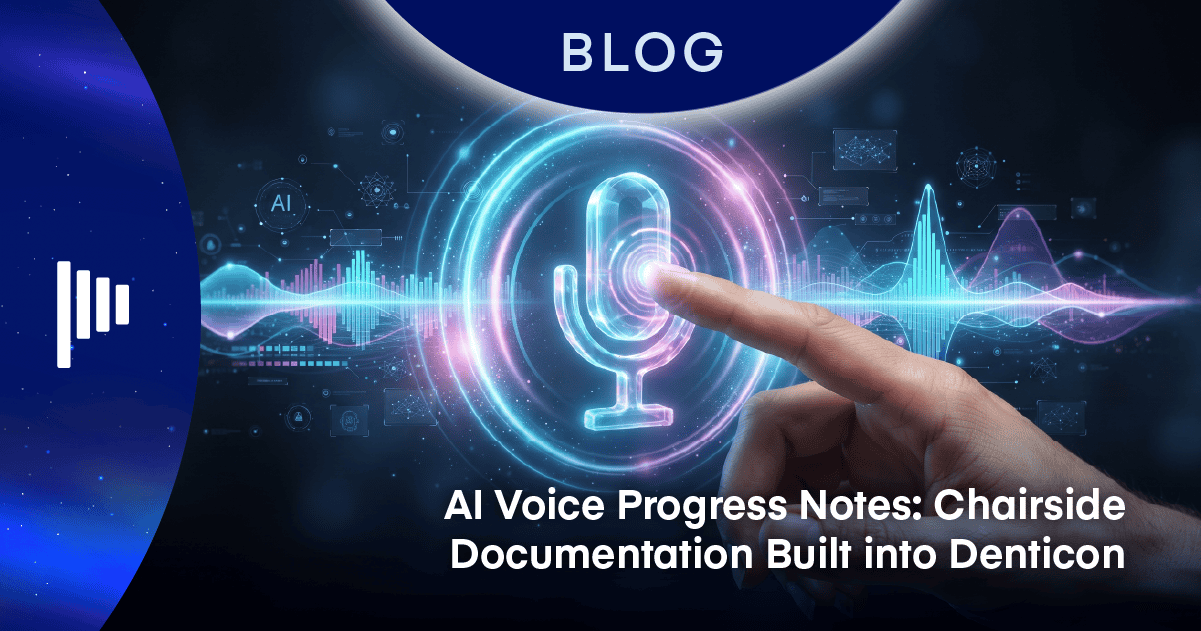
Documentation and data entry is a time-consuming process, requiring technology that can reduce administrative tasks. Clinical Voice+ is a suite of AI-powered voice documentation tools that charts clinical findings and completes progress notes in real time without needing to turn away from the patient or requiring another person’s assistance.
How Should a DSO Decide Which Problems to Fix First?
DSOs can decide which problems to prioritize using a framework that identifies exactly where problems exist and their impact on the organization. Key considerations include the financial impact, how quickly the problem compounds, the effort required for implementation, and how long it will take to see value.
Find where the money is leaking, and size it.
Look at claims in denial or pending status, aging receivables, incomplete treatment, unfilled appointments, no-shows, unused chair capacity, and administrative hours spent on manual processes.
Case acceptance usually gets the attention, but the average case-completion rate is just 47%—so the bigger leak is often treatment that’s accepted and never completed.
The goal is to turn a vague technology challenge into a measurable business problem. For example, “Our RCM process is inefficient” is difficult to prioritize, whereas “Twenty-five percent of our submitted claims are currently in denial or pending” is measurable and can be investigated directly.
Ask what compounds if you wait.
Some technology problems for DSOs become significantly more expensive as the organization grows. A manual process that is manageable across two or three locations becomes more challenging as more practices are added. Every acquisition can add another workflow, reporting structure, software system, or source of data.
The question shifts from “What is this problem costing us today?” to “What will this cost us after we add another ten locations?” A technology investment that prevents complexity from multiplying is more valuable than one that solves a larger but isolated problem.
Weigh effort against speed-to-value.
Look for opportunities where automation can eliminate repetitive work, improve an existing workflow, or make information immediately accessible. Appointment confirmation, recall, and claims workflows, payment processes, and clinical documentation all represent opportunities for targeted automation.
Separate business decisions from clinical ones.
Prioritize technology that reduces administrative work while keeping clinical judgments with the provider. For example, automation can handle appointment confirmations, claims follow-up, and routine patient communication while AI can draft clinical notes for a provider to review and approve. Technology automates the task; it does not make clinical decisions.
“Every major decision starts with a question,” said Huffaker. “Is this a clinical autonomy issue or a business autonomy issue? That framing alone has been worth more than most technology investments.”
Software, workflow, and reporting all fall on the business side of that line, and they run best on a platform built for the enterprise rather than a single office. The DentalOS platform provides end-to-end support for DSOs and multi-location dental groups by connecting billing, imaging, orthodontics, and AI on one data layer.
Prioritize technology by the problem it solves.
Use this guide to identify problems in need of attention alongside potential solutions:
| If the biggest problem is: | DSO technology leaders should prioritize: |
| Claims stuck in denial or pending | Revenue cycle automation |
| Front-office staffing pressure | AI-powered patient engagement and workflow automation |
| Inconsistent reporting across locations | Enterprise analytics and unified data |
| Missed appointments and unused capacity | Patient engagement and scheduling automation |
| Difficulty integrating acquisitions | Cloud-based enterprise infrastructure |
| Administrative burden on providers | Clinical AI and documentation |
| Multiple disconnected systems | An enterprise platform and connected data layer |
What Technologies Are DSOs Prioritizing Right Now?
The highest-value dental service organization technology investments are focused on revenue cycle automation, patient engagement, enterprise analytics, and AI that reduces administrative work and aligns optimal workflows together with profitability.
According to the ADA Health Policy Institute, 43.3% of dentists are now using AI for at least one task, and another 26.4% have plans to use it in the future, with near-term demand concentrated in administrative work like charting, insurance verification, and billing.
Revenue cycle automation
If a DSO is producing revenue but struggling with consistent collection, then RCM solutions that help automate eligibility, claims workflows, payment processes, and follow-up provide visibility into where revenue is getting stuck.
The Planet DDS 2026 Dental Industry Outlook: Deep Dive identifies revenue cycle performance as one of the largest opportunities for improving dental enterprise profitability. The key is to evaluate RCM as an enterprise-wide process rather than a collection of individual practice workflows.
AI-powered patient engagement
Patient communication such as confirmations, recall, cancellation recovery, and other routine interactions can be managed by AI agents with predictable workflows. They can escalate situations that require human intervention and can be particularly valuable when staffing is constrained. In fact, patients expect their providers, including dental providers, to match the level of digital sophistication they experience using apps and digital platforms in everyday life.
Instead of asking a front-office employee to spend part of everyday chasing routine confirmations, technology can handle predictable interactions while employees focus on patients and conversations that require a person.
Unified platform and enterprise analytics
As a DSO grows, it’s important to see the organization as one enterprise rather than a collection of individual practices. Enterprise analytics help leaders compare production, collections, scheduling, patient flow, and other key performance indicators (KPIs) across locations. But analytics are only as useful as the data behind them. If information is fragmented across systems, leaders may spend significant time assembling and validating data before they can act on it.
Clinical documentation and AI at the point of care
Clinical technology is increasingly focused on making documentation easier without removing providers from the process. The Clinical Voice+ Suite, for example, uses AI-powered voice technology to help providers capture clinical notes and documentation within the Denticon environment.
The potential benefit extends beyond saving individual minutes. When documentation workflows are standardized across an enterprise, DSOs can create more consistent processes while reducing administrative overhead for providers.
Why Does a Connected Enterprise Platform Outperform Other Systems?
A connected enterprise platform outperforms alternate systems because every report, automation, and AI agent draws on the same connected data instead of a patchwork of separate tools.
“Every capability we’re building—AI agents, clinical voice, predictive revenue cycle—performs relative to the quality of the data beneath it,” explained Nathan James, chief product officer at Planet DDS, who describes the approach “AI-native,” not AI-added. “We built the platform so that everything built on it today and in the future performs at a level disconnected tools never could.”
Why practice-level tools break at enterprise scale
Practice-level tools can be effective for single locations, but challenges emerge when the organization expands. Ask yourself these questions to understand the health of the organization:
- Which locations are missing collection targets?
- Where are claims getting stuck?
- Which practices have unused capacity?
- Which workflows produce better results?
- Can a process change be implemented consistently across locations?
- Can leadership access the same information without waiting for manual reporting?
When answering those questions requires spreadsheets, exports, reconciliation, or calls to individual locations, the organization is paying a process-debt tax. The problem is not necessarily that the individual tools are bad; they were not designed to function as the infrastructure of a large dental enterprise.
What Does the Modern Enterprise Platform Look Like?
The modern enterprise platform is designed to support the organization as one connected system rather than a collection of seperate practices.
That means data can move across locations, systems can communicate through integrations and APIs, and enterprise leaders can access reports without relying on manual reconciliation. It also creates a foundation for adding new capabilities.
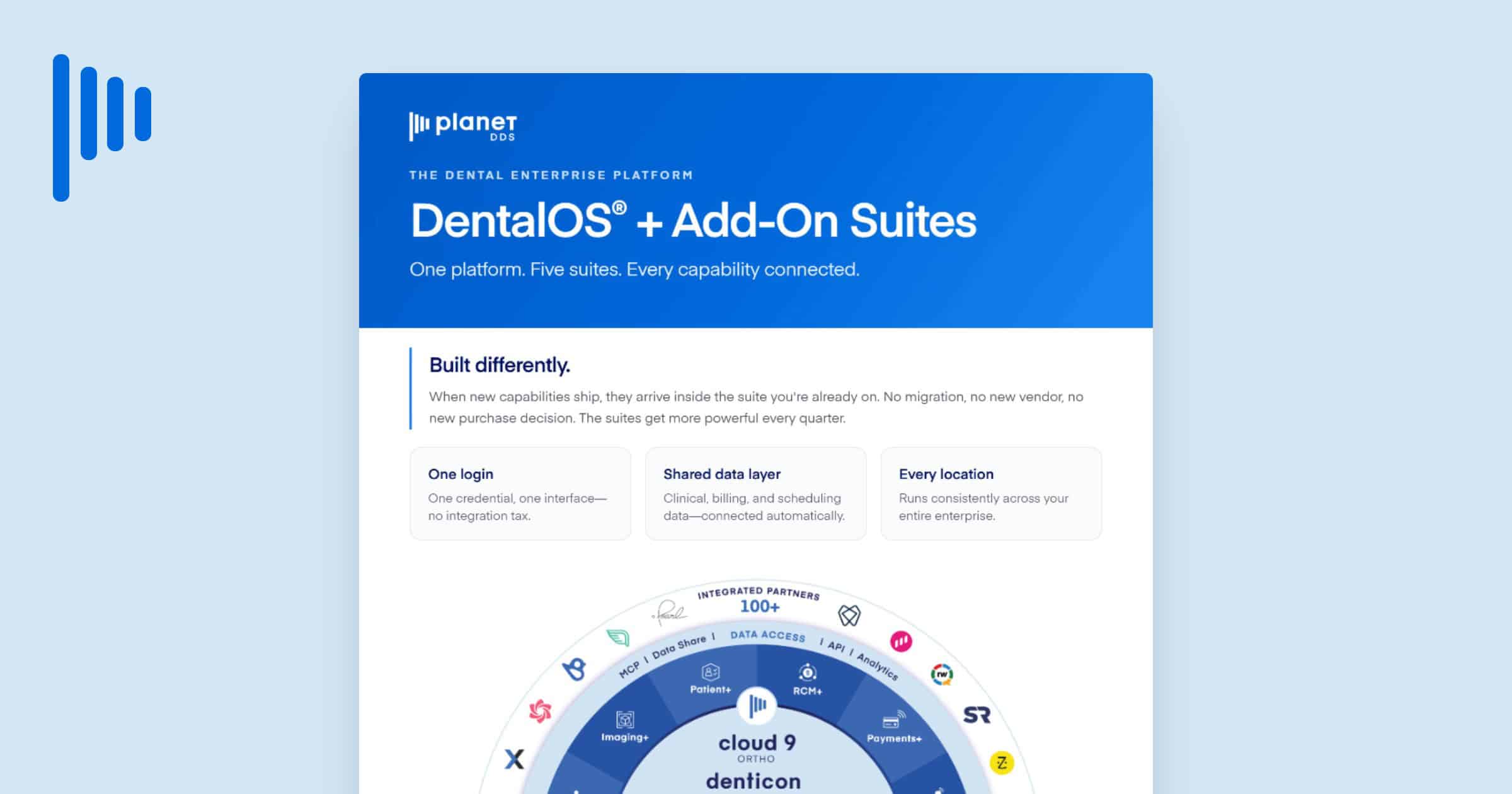
DentalOS connects Denticon and Cloud 9 on one shared data layer, bringing practice management, imaging, payments, orthodontics, and AI together through an enterprise platform. It provides the features needed within each location while supplying the infrastructure that allows those features to work together.
These tools are delivered as DentalOS Add-On Suites, each running on that same data layer, security model, and login:
- Agents+ Suite: AI agents that confirm, recall, and rebook patients across locations
- Clinical Voice+ Suite: Hands-free AI charting for perio, restorative, and progress notes
- Imaging+ Suite: Enterprise imaging with expanded storage, 3D, and analytics
- Patient+ Suite: A consistent patient experience across scheduling, intake, and recall
- Payments+ Suite: Embedded payments that post to the record automatically
Because these suites share that same base, a group can add a new capability inside one it already uses instead of onboarding a separate system or vendor.
What Should Be on a DSO Technology Roadmap?
A strong DSO technology roadmap that supports optimal dental practice operations begins with insight into measurable operational leaks, prioritizes problems that compound with growth, and favors connected infrastructure over isolated point solutions. The goal is to build an organization where technology creates more leverage as the DSO grows.
A practical DSO technology roadmap starts with five steps:
- Audit the leaks. Identify where revenue, time, capacity, or patient opportunities are being lost.
- Size the opportunity. Put a financial or operational number against each problem. If you cannot measure the problem, it will be difficult to measure the technology’s impact.
- Prioritize compounding problems. Give additional weight to issues that become more expensive with every acquisition or new location.
- Look for automation before adding headcount. Determine whether repetitive administrative work can be handled through workflow automation or AI.
- Connect the data. Make sure the technology you select can share information with the rest of your ecosystem rather than creating another silo.
DentalOS connects every part of practice management together, enabling the DSO technology infrastructure to match the needs of growing organizations.
What Should DSOs Look for in Dental Practice Management Software?
DSOs should evaluate dental practice management software based on more than individual-practice functionality and instead question whether it will make the next stage of growth easier to operate.
A useful evaluation checklist includes:
- Connected data: Can information move across locations and workflows?
- Cloud-native infrastructure: Can the system support a growing multi-location organization?
- Enterprise-grade security: Is there one security model and access control across every location?
- Open APIs and integrations: Can the platform connect with the other technologies the DSO needs?
- Enterprise visibility: Can leadership access standardized information across locations?
- AI capabilities: Is AI integrated into workflows rather than added as a separate layer?
- Scalability: Will adding another acquisition or location increase complexity—or become easier to manage?
- Extensibility: Can new capabilities be added to the same platform without a separate system or vendor?
The strongest software choice isn’t the one with the most features; it’s the one that makes each new location easier to run than the last.
Turn DSO Technology into Measurable Growth
To prioritize DSO dental technology right now, start with operational problems that have the largest measurable cost, become more expensive as the organization scales, and can be improved through automation or better access to data. Then address those problems with integrated technology rather than adding more disconnected point solutions.
A unified enterprise platform can provide the groundwork for what comes next, helping DSOs move from practice-level systems and processes toward technology designed for the modern dental enterprise.
Explore DentalOS to see how an integrated platform can support enterprise-wide dental operations and growth.