How Imagen Dental Partners Raised Time-of-Service Collections from 65% to 85% with Denticon
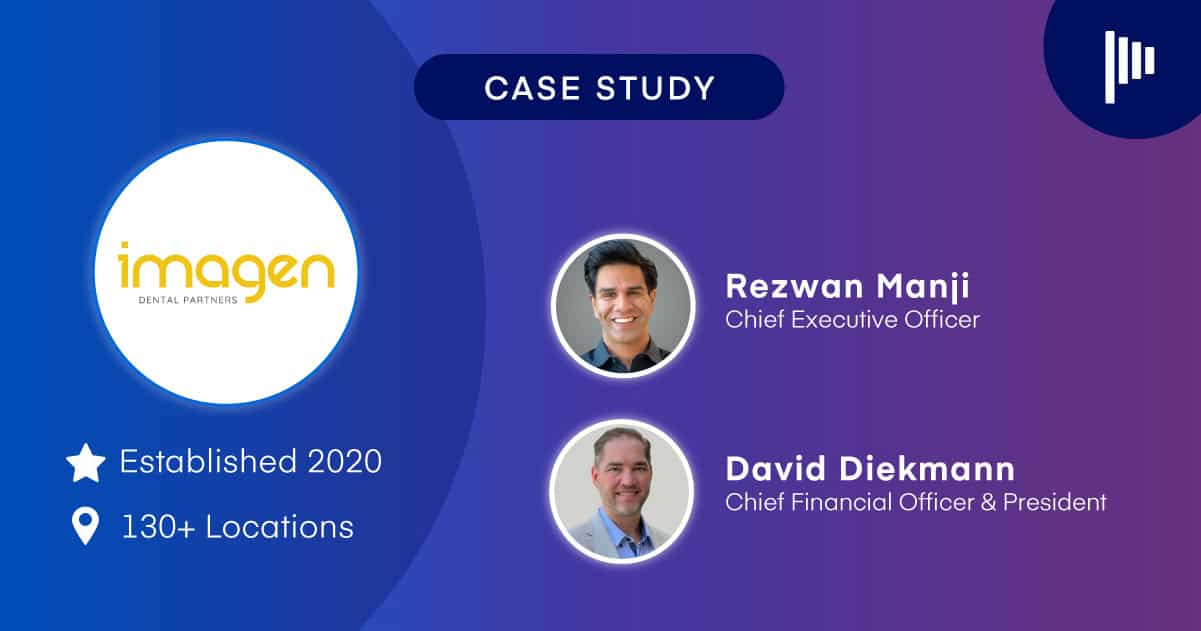
Revenue cycle performance remains a significant opportunity for many dental organizations, and Imagen was no different. Improving revenue cycle amid changes within the dental space is an opportunity that Rezwan Manji, CEO of Imagen Dental Partners, is seeing playing out across the entire industry.
“The dental industry is in the middle of a correction, and that is not new news,” said Manji. “Everyone understands the pressures: higher capital costs, labor challenges, reimbursement constraints, and greater scrutiny on performance. The more important question is how organizations are responding.”
For David Diekmann, CFO and president of Imagen Dental Partners, that gap isn’t just an operational nuisance. Imagen operates on a 60/40 joint venture structure. Partner doctors own 40% of their practices, and a significant part of their compensation comes from cash distributions. If collections lag, distributions lag, and the model that differentiates Imagen in the market begins to erode trust.
“I wanted Imagen Dental Partners to be known as the best revenue cycle function in all of dentistry,” said Diekmann. That wasn’t an aspirational statement. It was a strategic imperative, and it drove Imagen’s decision to move more than 130 practices onto Denticon, migrating off a fragmented landscape of Dentrix, Eaglesoft, and ten other practice management systems that made centralized RCM impossible.
Why the Incumbent Systems Couldn’t Get Them There
Before Denticon, Imagen operated across twelve different practice management systems. Dentrix and Eaglesoft dominated the portfolio, familiar to doctors, but built for single-location practices in an era before DSO-level accountability existed at single-location practices.
While these solutions work well for independent or single location practices, there were limitations for Imagen’s growth strategy. Eaglesoft was server-based with data stored at each location, creating challenges for centralized reporting or multisite visibility. Dentrix also required workarounds to operate at scale and neither could offer standardization and visibility for a larger, multisite organization like Imagen.
Neither could give his team the clean, unified data necessary to train operations managers consistently or build toward the AI-enabled future he was planning for.
“One of the lessons we quickly learned was that we needed to standardize on a single solution in order to run the business,” said Manji. “So we decided to pivot from having disparate systems that required us to normalize the data.
“The number one correlation between a financially successful practice and one that’s not is how effective is the operations manager,” said Diekmann. “I can’t train 100 operations managers if they’re all using different systems.”
Diekmann evaluated Denticon against three criteria that quickly narrowed the field: organization-level reporting, security (SOC 2 Type 2), and vendor-friendly API architecture that could support the integrations Imagen would need as it scaled. The alternatives didn’t clear the bar.
A 20-Point Swing That Moved Imagen Dental Partners
Time-of-service collections, or the percentage of patient-responsible balances collected at the chair before the patient leaves, is a metric Diekmann watched closely.
“You go get a haircut, they don’t let you leave until you pay,” said Diekmann. “But in dental, for some reason, we’ll get it later. Our time-of-service collections at Imagen, pre-Denticon, we were at 65%. We set a target of 80% as an initial milestone, which we have exceeded and now at 85%. Our next goal is 90% in 2027.
The improvement wasn’t a product of technology alone. Diekmann’s team standardized treatment plan presentation, ensured consistent pre-appointment insurance verifications, and implemented operations manager training on these processes.
They used the Denticon transition as an opportunity to redesign revenue cycle workflows from the ground up, pairing the platform’s configuration capabilities with a comprehensive rethink of how the front office operated at every practice.
For Manji, the payoff of a single platform reaches well beyond any one metric: “You’re able to make decisions quicker. It makes the operating teams’ lives easier. You’re able to move quicker, move more accurately, and have more confidence.”
Inside the Implementation: Lessons for Multi-Location DPOs and DSOs
Imagen’s rollout wasn’t without friction. The first wave of implementations surfaced real challenges—and the candor of Diekmann and Manji about what went wrong, and how the team recovered offers some of the most practical guidance available for any DPO navigating a platform migration.
1. Operations must be embedded in the implementation process.
The first rollout wave stalled because operational leaders weren’t embedded in the process. Without operational buy-in at the practice level, adoption struggled. The fix, developed with the Planet DDS implementation team, put operations managers on-site, trained them in advance of go-live, and made them accountable for securing clinical and practice-level readiness.
“We definitely underestimated the process re-engineering and the workflow changes,” explained Diekmann. “We did not have operational buy-in.”
2. Workflow redesign is the work. Denticon is the enabler.
The platform doesn’t automatically create better collections. What it does is make better workflows possible and then enforce them. Imagen’s 20-point RCM improvement came from pairing Denticon’s front-office configuration capabilities with a ground-up redesign of its revenue cycle process.
3. Clinical buy-in requires its own strategy.
Partner doctors in a JV model have real ownership stakes and real opinions about their workflows. Diekmann learned that getting them on board requires answering the “why” in terms that matter to them: production, distributions, and the quality of care they can deliver. Planet DDS supported this through demo access, clinical workflow documentation, and the flexibility to preserve key integrations so doctors didn’t feel like they were trading capability for standardization.
“We try to move the business forward through the art of influence, not by telling them, mandating this is what we’re going to do,” said Diekmann.
Manji credits Imagen’s community of partner-shareholders, and full transparency with them, for turning doctors into advocates for the migration.
“When you simply explain to them and you’re completely transparent with them—here’s where we are, here’s what we’re experiencing, and here’s where we need to go and why—ultimately, people are logical human beings,” said Manji. “And so now they become an advocate.”
4. A partner that listens makes the difference.
What kept the implementation on track through the reset wasn’t just technology; it was the working relationship. Imagen brought pain points directly to Planet DDS, and the team responded with configuration adjustments, workflow guidance, and continued investment in the tools Imagen had flagged as critical. That feedback loop is now a durable part of how the two organizations work together.
Asked what he would do differently, Manji doesn’t hesitate. “If I were to go back in time, I would probably have made that decision day one, to normalize and standardize,” said Manji. “We are huge believers in the back-office functions having some logical standardization associated with it. And it starts, frankly, with the PMS.”
The Long Game: Building a Model That Ensures Continuity
For Diekmann, the platform investment is one piece of a broader strategic vision. Sustaining that growth requires clean data, scalable operations, and a technology foundation that can support AI-driven decision-making as the industry evolves.
“At some point, my partners will want to retire,” said Diekmann. “And if they’re doing $8,000 a day in production, and I backfill up with an associate doing $3,000 a day, I just went backward.”
But Diekmann’s longest-term concern is one that gets less attention in industry conversations: succession. The Planet DDS 2026 Dental Industry Outlook: Deep Dive report reinforces why this matters: Larger, more mature practices are in an optimization phase, not a growth phase.
The infrastructure required to replace a high-producing partner doctor with an equally capable associate requires exactly the kind of standardized systems, consistent training, and clean data that Denticon now enables at Imagen.
Manji frames the Denticon migration as the foundation for everything that comes next. “A common practice-management platform is table stakes and gives us the data consistency, workflow visibility, and operating foundation required to scale effectively,” said Manji.
With that foundation taking shape, Imagen has moved beyond simply encouraging teams to experiment with AI. Across accounts receivable, revenue cycle management, human resources, operations, and other functions, teams are already replacing legacy processes and manual workflows with AI-enabled approaches built around specific, well-defined use cases, freeing people to spend more time solving problems, supporting practices, and making better decisions.
“Ultimately, we are moving from viewing technology as a collection of features or tools to treating it as an operating system for the business,” said Manji. “The goal is not to have the most tools. It is to use the right technology to make Imagen simpler, more responsive, and more effective.”
Standardize Your Revenue Cycle for DSO Growth
For Imagen Dental Partners, implementing Denticon created a unified operating model across every practice.
By standardizing workflows, training, and data on a single platform, the organization strengthened collections and cash flow for its partner doctors while preparing the business for long-term growth.
Ready to give your revenue cycle the competitive advantage? Request a demo today.