How Dental365 Turned Full Integration into a Competitive Advantage with Denticon
Consolidation defined the last decade of dentistry. An estimated 150 to 300 DSOs now hold 20 to 25 percent of all dental offices in the country, and the top 20 groups nearly doubled their location count in under a decade, according to the Planet DDS 2026 Mid-Year Dental Industry Outlook.
That growth produced extraordinary scale—but not always the infrastructure to run it. Now, as capital tightens, some dental support organizations (DSOs) are defaulting on their loans and handing their businesses back to the bank.
Dr. Joshua Gish, president of Premier Care Dental Management (PCDM) and chief oral surgery officer at Dental365, has been candid about the root of the problem.
“When organizations are built around financial engineering instead of clinical infrastructure, they hold up fine when money is cheap and investors are eager,” said Dr. Gish. “But the market changed, and now we’re seeing which models were actually built to last.”
Dental365 was built differently. Founded in 2014 by Dr. Scott Asnis, the organization describes itself as a dental clinical organization (DCO), a group committed to placing clinical care at the heart of everything it does, with comprehensive general and specialty dental services delivered across New York, Connecticut, New Jersey, Pennsylvania, Ohio, New Hampshire, Massachusetts, and Rhode Island.
Its mission: empower clinicians to provide exceptional care while fostering innovation, collaboration, and continuous improvement in dental outcomes.
“As headwinds increase—and we all see that there are headwinds—a real lack of infrastructure means that you can’t make meaningful progress in your organization,” said Dr. Gish. “The key driver for us for margin expansion and revenue growth is actually better dentistry. It’s not trying to financially figure out how to be more productive; it’s just doing better dentistry.”
The stakes of getting it wrong, he explains, land on the people the model was supposed to reward.
“These overly leveraged groups will default on their covenants,” said Dr. Gish. “They’re in true financial trouble, and the first person to lose money is the dentist that was promised this carrot down the line.”
Why Light-Touch DSO Consolidation Doesn’t Scale
Dental365 has spent the last several years stepping in where larger groups have struggled—absorbing, stabilizing, and fully integrating them. This includes four to five such groups so far, ranging from six to ten offices each, across New Jersey, Massachusetts, Pennsylvania, and Ohio: organizations that had already gone through one transition and needed a partner that could actually follow through.
“The next wave of consolidation in dentistry isn’t going to look like the last one,” said Dr. Gish. “It won’t be about who can grow the fastest. It’ll be about who’s actually built to absorb, stabilize, and elevate.”
That conviction rules out the light-touch integration playbook many consolidators relied on in the growth era: letting acquired practices keep their own systems and calling it partnership.
“Those days are over of just barely integrating groups and saying that they’re a part of your organization,” said Dr. Gish. “You have no leverage. You have no ability to make change. You can’t even consolidate data. Once you’re on one practice management platform, you can have centralized revenue cycle. You can implement technology. And then you can also standardize clinical protocols because that protects your patients.”
For Dr. Gish, that last point is where integration stops being an IT decision and becomes an identity.
“People always talk about culture,” said Dr. Gish. “Culture is standardized clinical protocols. Our culture, interestingly enough, is that we’re not dentist advocates. We’re patient advocates, and you can only say that when you’re fully integrated. You have no control otherwise.”
The Outcome: Full Integration in Three Weeks with Denticon
Most DSOs measure integration timelines in quarters, if they finish at all. On Denticon, Dental365 measures it in weeks. That pace is possible in part because Dental365 is deliberately selective, walking away from prospective offices when full integration isn’t the right fit.
“At Dental365, all of our practices that we acquire and groups that join us are integrated, fully integrated within three weeks,” said Dr. Gish. “I mean, that’s unheard of. We always say, we don’t have a light touch. We don’t have a heavy touch. We have our touch.”
That discipline—one platform, one protocol set, one culture—has powered growth rather than constraining it. Since joining what is now PCDM and Dental365 about seven years ago, Dr. Gish has worked alongside Dr. Scott Asnis to help build the organization to close to 170 offices in eight states, with roughly 30 percent of practices operating as standalone specialty offices alongside general dentistry locations in rural, urban, and suburban communities.
Inside the Playbook for Dental365: Lessons for DSOs Acquiring Groups
Becoming a “consolidator of consolidators” isn’t a slogan at Dental365; it’s an operating discipline built over years of diligence, hard conversations, and a platform decision that made the rest possible. Dr. Gish offers practical guidance for any DSO evaluating its next move.
1. Build the infrastructure before you need it.
Dental365 started small and scaled deliberately, so growth never outran the organization’s ability to support it.
“We built out our infrastructure to be able to support before we made any large moves,” said Dr. Gish. “Anytime we evaluate any practice or group of practices, the first question in our room is always, can we do this? How can we support this? Even down to saying, hey, give me a list of the people who are going to be involved in this transition. Are they available?”
2. Diligence means evaluating the infrastructure you’re inheriting.
Every deal review looks past the profit and loss (P&L) to the systems, the people, and the philosophy of the group being absorbed, including conversations with the doctors and staff, and even a review of doctor schedules to model how they will translate onto Dental365’s practice management software.
“We actually have learned to evaluate the existing infrastructure as part of our diligence,” said Dr. Gish. “We try to look at where they tripped up, what worked, what didn’t work, and what philosophical differences they have from what we do.”
Sometimes that diligence surfaces talent, not just risk. One of the first groups Dental365 brought on board in Massachusetts had strong operators in the wrong positions, the “true athletes,” as Dr. Gish calls them, who are now instrumental in the day-to-day business of the organization.
3. Full integration starts with full informed consent.
Dental365 tells every prospective practice exactly what joining will look like and walks away when the fit isn’t right.
“That starts with a full informed consent to the doctors and with their staff so they understand what they’re getting themselves into,” said Dr. Gish. “We’ve said no to over three hundred offices in the past twelve months. We say, listen, the hardest thing you’re going to do is change your practice management software, but there’s a reason for it.”
4. A partner you can push back on makes the model durable.
The relationship with Planet DDS runs on the same candor Dental365 brings to its acquisitions: a shared wish list, honest feedback, and a willingness to adapt on both sides.
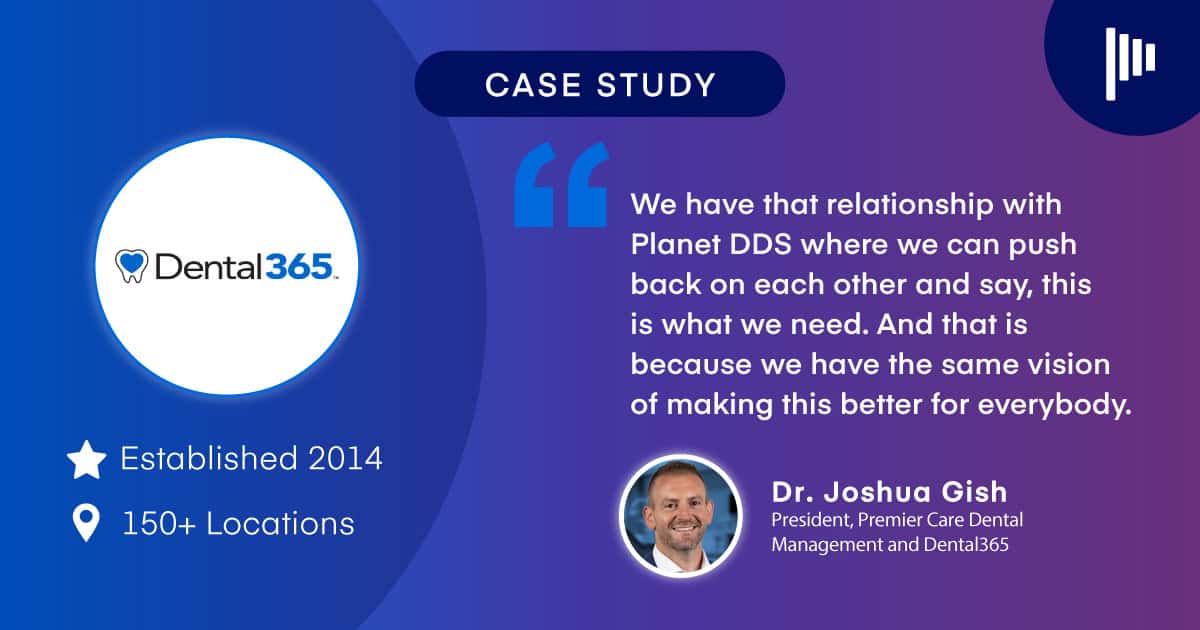
“We’ve felt the support, and we’re not easy,” said Dr. Gish. “We have that relationship where we can push back on each other and say, this is what we need. And that is because we have the same vision of making this better for everybody.”
It’s an approach rooted in his broader operating philosophy.
“You always have to be reevaluating,” said Dr. Gish. “You always have to look to take a step back and say, hey, we made a mistake. Let’s just fix it, or let’s not do that again. Don’t be afraid to make a decision. Don’t get paralysis by analysis.”
An AI-Ready Enterprise on One Platform
The next test of infrastructure is already here. Every major AI capability entering dental—scheduling, documentation, revenue cycle, imaging—requires clean, connected, enterprise-wide data to deliver real value. Groups on a unified platform get dramatically more from every AI investment; groups on fragmented stacks get a fraction of that value, and the gap widens every year.
Denticon, part of the Planet DDS DentalOS® platform, gives Dental365 that single data layer, and Dr. Gish has watched it become the deciding factor.
“One of the biggest things, every meeting is talking about technology, whether it be automation, AI,” said Dr. Gish. “Anybody can go off the shelf and purchase an automation product or an AI tool. But if your systems are fragmented, you won’t be able to implement it. Where’s the data coming from? Where is it stored? How are you layering on these AI tools?”
Dental365 is already living that lesson inside its own operation.
“Even within Denticon, and this is a very unique case study, we’ve noticed this with some of the AI tools that we’ve rolled out through Denticon,” said Dr. Gish. “We’ve actually had to reorganize our centralization to make sure that it’s optimized better for 835 automations and things like that. You can’t do it if you’re all over the place.”
His advice to the DSO leaders still running on fragmented systems is unambiguous.
“You have to understand that this is your number one priority,” expressed Dr. Gish. “The writing is on the wall; it’s very obvious that you can’t stay in the game if you’re fragmented. You won’t be able to adapt. You won’t be able to implement new technology. We always say the tide is going out, and there’s just no leeway for businesses that are not optimized and not centralized. So put everything else on hold and get under one system because it’s just moving too fast.”
For groups that make the move, the payoff isn’t just operational; it’s the answer to every criticism the DSO model has ever drawn.
“We are a dental clinical organization,” said Dr. Gish. “We are centralized. We are making the patient experience better. We’re doing better dentistry. We’re allowing our patients to actually have the least amount of dentistry in their life instead of constantly redoing procedures.”
Centralize Your Operations to Build a DSO That Lasts
For Dental365, full integration on Denticon is the starting point that makes everything else possible: centralized revenue cycle, standardized clinical protocols, and a clean data layer ready for AI. By committing to one platform and one culture, Dental365 has turned operational discipline into clinical and business strength, becoming the kind of organization the dental enterprise era rewards.
Ready to make integration your competitive advantage? Contact us today.