Dental Marketing Platforms: Integrated Solutions for Multi-Location Growth
The dental industry spent a decade growing by acquisition. The goal was adding locations; now the challenge is running those locations well—with dental marketing becoming even more difficult when systems aren’t connected.
With an estimated 150 to 300 DSOs now representing 20 to 25% of U.S. dental offices, dental organizations have achieved significant growth. But as dental support organizations (DSOs) and groups add practices, the system responsible for attracting patients, scheduling appointments, communicating with them, managing reputation, and measuring results also must scale.
Multi-location organizations need a dental marketing platform that can support centralized strategy and local execution, connect patient acquisition with ongoing engagement, and exchange data with the dental practice management system running the organization.
That means evaluating not only marketing capabilities but also patient engagement, multi-location functionality, integration, and how the technology fits into the organization’s broader dental technology ecosystem.
Which Dental Marketing Platforms Support Patient Engagement Across Multi-Locations?
Dental marketing platforms that support patient engagement share these requirements: centralized control, location-level execution, and real-time integration with the practice management system.
The patient journey moves through scheduling, intake, reminders, treatment, recall, reviews, and reactivation. When the software responsible for those interactions cannot communicate with the systems running the practice, teams are left reconciling information manually and leaders lose visibility into what happened after the initial conversion.
“I’ve never met a DSO leader who said their biggest problem was finding the right dental practice management software,” said Mike Huffaker, chief revenue officer of Planet DDS. “They talk about visibility, scale, AI, and operational consistency across dozens of locations. They’re looking for a platform that matches the ambition of what they’ve built.”
The Planet DDS DentalOS® platform was created for this type of growth: “DentalOS is our answer to the dental enterprise era,” said Eric Giesecke, chief executive officer of Planet DDS. The DentalOS platform supports self-scheduling, digital intake, and automated recall and marketing, all on one shared patient record, with an open ecosystem of more than 100 integrated partners.
What Features Should a Dental Marketing Platform Include?
No single feature delivers patient engagement. It takes several coordinated functions that move prospective and existing patients through various stages of their journey. For multi-location dental groups, core capabilities include:
Centralized patient communication
Automated reminders, confirmations, two-way texting, recall, and other communications help practices maintain contact and build the patient experience. At the enterprise level, organizations also need the ability to standardize workflows while keeping communications relevant to the location and provider involved.
Online scheduling and digital intake
Patient acquisition becomes more effective when people can move directly from discovery to appointment. A recent Press Ganey report found that 80% of healthcare consumers say online scheduling influences their choice of provider, while nearly a quarter will look elsewhere if booking an appointment is not sufficiently easy.
Reputation and local marketing
Dental discovery remains local, even when the organization behind a practice is regional or national. Each location needs accurate information and a healthy online presence in its own market.
Marketing automation and reactivation
Marketing is not limited to acquiring first-time patients. Recall, reactivation, and targeted outreach can help dental organizations reconnect with existing patients and fill available capacity without depending exclusively on new-patient acquisition.
AI and automation
AI can increasingly take on repetitive patient engagement workflows such as confirmations and recall. The value at enterprise scale is not simply doing a task faster; it is applying a consistent workflow across locations without requiring staff at every office to perform the same repetitive work.
These capabilities compound when they run on one shared patient record rather than separate tools. The common thread is data. “Every capability we’re building—AI agents, clinical voice, predictive revenue cycle—performs relative to the quality of the data beneath it,” said Nathan James, chief product officer of Planet DDS.
What Makes a Dental Marketing Platform Enterprise Ready?
Not every dental marketing platform is designed to support a multi-location enterprise. For DSOs and growing dental groups, several features become increasingly important at scale:
Centralized dashboards with role-based permissions
Enterprise leadership may need visibility across the organization, while regional leaders need access to their markets, and individual practice teams need the information relevant to their locations. The platform should accommodate those different levels of access without creating separate systems.
Location-level execution
Centralization should not erase local context. Appointment availability, providers, services, reviews, and market conditions vary by location. Groups need to establish enterprise standards while still allowing marketing and patient engagement workflows to respond to what is happening at each practice.
Consistent brand and patient experience
Growth can create variation in how locations communicate with patients, particularly after acquisitions. Centralized templates and workflows can help establish consistency without forcing every interaction into an identical script.
Native integration instead of repeated data entry
If teams move patient information between systems, reconcile appointment changes manually, or maintain separate lists for campaigns, the technology creates additional process debt as the organization grows.
Cross-location analytics
Leaders should be able to compare locations and understand what happens after marketing generates demand. That includes linking acquisition and patient engagement activity with scheduling and operational performance rather than evaluating marketing only through clicks, impressions, or leads.
Flexible technology
An enterprise platform should not require the organization to rebuild its technology strategy every time it adopts new marketing, communications, analytics, or AI solutions. This is where API strategy becomes a meaningful part of the evaluation.
The clearest test is what happens to information as it moves between systems. A collection of point solutions can work well and still leave the organization with separate data sources, logins, and reports; an enterprise strategy should unify them.
Why Do Open APIs Matter for Dental Marketing Platforms?
An application programming interface, or API, provides a structured way for authorized software applications to exchange data and perform defined actions. In practical terms, an open API can allow a marketing or patient engagement application to connect with information already stored in the practice management system rather than requiring staff to maintain the same information in multiple places.
APIs connect marketing with practice operations.
The depth of integration matters. Simply transferring a patient list into another application is different from giving an authorized platform structured access to current appointment, patient, provider, or location information. DentalOS open APIs can support connections across several types of data and workflows:
- Patient information. APIs can allow authorized applications to retrieve patient information and, depending on the endpoint, create or update records. For engagement platforms, that can help keep communications tied to current patient data rather than a periodically exported list.
- Appointment and scheduling data. Applications can work with appointment and scheduling information, which is particularly important for online booking, reminders, confirmations, recall, and other schedule-related engagement.
- Practice and provider information. Access to organizational data allows integrated applications to associate activity with the appropriate location and provider, an essential requirement when the same dental group operates in many offices.
- Writeback capabilities. A useful integration does not always stop at reading data. Defined API endpoints can allow an application to return information or actions to the underlying system, reducing the need for staff to document the same activity again.
The exact data and actions available depend on the API and individual integration. Being an integration partner does not mean every application has unrestricted access to every piece of patient data or can perform every action.
Open APIs give dental groups more technology choices.
The strategic value of an open API is flexibility. A closed ecosystem can make integration easier when an organization uses only that vendor’s products, but it can also limit what happens when a DSO wants to introduce a specialized platform that better fits a particular workflow.
DentalOS supports greater flexibility, with open APIs and integrated partners. “Great dental enterprises should run the best tools in the industry, and those tools should work together natively without forcing a workaround or adding a vendor,” said James. “This is not a technical preference. It is a belief about who should be in control: the operator, not the software vendor.”
Open APIs give dental organizations greater control over which technology they use while maintaining a consistent operational foundation.
Which Dental Marketing Platforms Can Integrate with DentalOS?
The DentalOS open ecosystem gives dental groups the choice to use specialized marketing and patient engagement technology alongside the capabilities available through the platform. Marketing and patient engagement applications that integrate with DentalOS include:
- Adit: Combines dental marketing (SEO, websites, advertising) with patient communications, reviews, forms, and online scheduling
- IntelePeer: Automates patient communication across voice, SMS, and digital channels for scheduling, outreach, and collections
- Podium: Supports reputation and local marketing through reviews, listings, and two-way patient messaging
- SocialClimb: Supports healthcare marketing, reputation management, and patient acquisition through reviews, listings, and patient-growth campaigns
- Solutionreach: Supports patient communication through appointment reminders, recall, two-way messaging, and digital patient engagement
- Weave: Provides patient communication and engagement through messaging, reminders, reviews, and other front-office workflows
- Zocdoc: Extends patient acquisition through online discovery and booking, connecting prospective patients with available appointments
For multi-location dental organizations, the larger advantage is choice: Groups can select specialized technology for acquisition, reputation, communications, scheduling, and other functions while keeping those tools connected to the enterprise platform.
How Does Patient Engagement Drive Dental Practice Management Growth?
Engagement is not simply a patient experience metric. It affects whether demand turns into appointments, whether patients return, and whether accepted treatment ultimately reaches completion.
New-patient volume creates opportunities.
Planet DDS data across thousands of practices shows a meaningful inflection point in new-patient volume. According to the Planet DDS 2026 Mid-Year Dental Industry Outlook, practices begin to see growth accelerate at around 35 new patients per month.
A marketing platform may generate new-patient demand, but growth also depends on converting that demand into scheduled appointments and maintaining the relationship after the first visit.
Reputation extends the patient’s journey back into acquisition.
Patient engagement also feeds future acquisitions. The experience a patient has with scheduling, communication, treatment, billing, and follow-up can eventually become the review that influences the next prospective patient.
BrightLocal’s 2026 research found that 97% of consumers rely on reviews when making purchase decisions and that 66% continue researching after reading a positive review rather than immediately making a purchase or booking.
Retention and treatment follow-through support growth.
The Planet DDS mid-year report also illustrates how much opportunity remains after patients enter the practice. Across the practices analyzed, average case completion was 49%, while average case acceptance was 61% and average hygiene reappointment was 66%. These benchmarks reinforce that generating new patients is only one part of growth; organizations also need visibility into patient care and follow-through.
How Do DentalOS Add-On Suites Support Marketing and Operational Needs?
The DentalOS Add-On Suites extend the enterprise platform with capabilities designed to address specific marketing and operational needs. Each suite runs on the same platform, so patient engagement and daily operations stay connected.
- Patient+ Suite delivers one consistent patient experience across every location: online scheduling through MyTooth, digital intake and consent, and automated recall and marketing campaigns.
- Agents+ Suite puts AI agents on the phone to confirm, recall, and rebook patients with automated calls, turning missed calls into booked visits across every location.
- Payments+ Suite embeds payments that are posted to the record the moment they’re collected, giving patients a faster, cleaner checkout with card on file and automated financial reminders.
- Clinical Voice+ Suite gives providers hands-free AI charting for perio, restorative, and progress notes, so documentation ends when the visit does, and attention stays on the patient.
- Imaging+ Suite brings enterprise imaging—expanded storage, 3D, and analytics—inside DentalOS, so patients get clearer explanations and consistent imaging at any location.
All five suites run on the same patient record, so engagement gets sharper as more of the enterprise connects to it. That advantage compounds every year the data stays connected.
What Should DSOs Ask When Evaluating Dental Marketing Platforms?
For DSOs and multi-location dental groups, a dental marketing platform must fit the organization’s operating model, work with its existing systems, and keep up as the group grows.
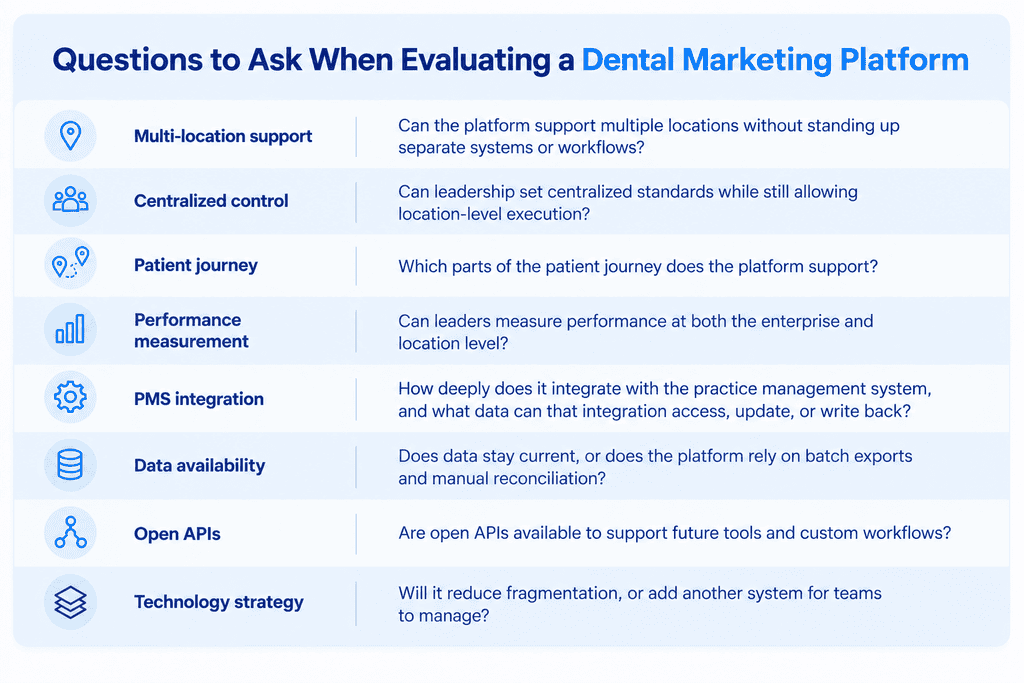
Answering these questions helps reveal whether a platform can become part of a connected marketing strategy rather than another isolated tool—a distinction that matters more with every location, system, and patient touchpoint your organization adds.
Choose a Dental Marketing Platform That Scales
For DSOs and dental groups, the best dental marketing platform keeps patient engagement consistent across every location while working with applications their teams already trust.
That’s what an open platform like DentalOS is built to do: Run acquisition, engagement, scheduling, reputation, and operations on one foundation, while its open APIs and integrations bring in the specialized tools each group already relies on. Get that foundation right, and marketing stops being a set of disconnected tools and starts working as one system that grows with the organization.
Explore DentalOS and the connected Planet DDS ecosystem.