The Era of the Dental Enterprise
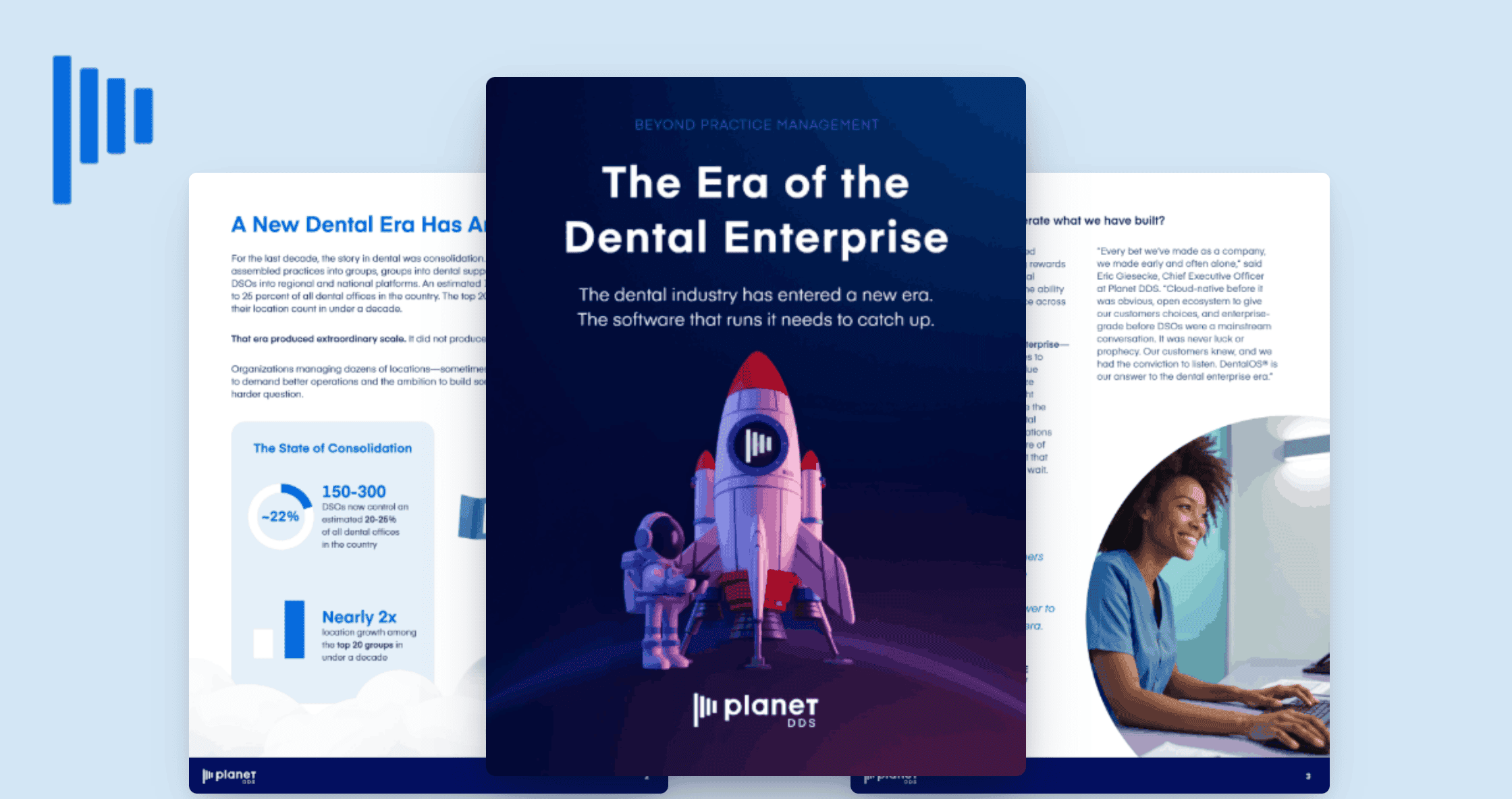
For the last decade, the story in dental was consolidation. Private equity assembled practices into groups, groups into dental support organizations (DSOs), and DSOs into regional and national platforms—an estimated 150 to 300 DSOs now hold 20 to 25 percent of all dental offices in the country. That era produced extraordinary scale. It did not produce the infrastructure to run it.
The Era of the Dental Enterprise was written for the DSO and dental group leaders now facing a harder question: How do we actually operate what we’ve built? It examines the structural shift under way—from an acquisition phase that rewarded speed to a new era that rewards operational discipline, data visibility, and consistent performance across every location—and makes the case for a fundamentally different kind of dental software to power it.
What’s Inside The Era of the Dental Enterprise
One theme runs throughout: The industry has entered the era of the dental enterprise—a structural shift in what it takes to compete, grow, and create value in dental. Groups that recognize this moment and make the right infrastructure decision now will define what dental looks like in 2030. Those still running on the infrastructure of the last era are carrying a cost that compounds every month they wait.
“Every bet we’ve made as a company, we made early and often alone,” said Eric Giesecke, CEO of Planet DDS. “Cloud-native before it was obvious, open ecosystem to give our customers choices, and enterprise-grade before DSOs were a mainstream conversation. It was never luck or prophecy. Our customers knew, and we had the conviction to listen. DentalOS® is our answer to the dental enterprise era.”
Here’s a look at the forces, evidence, and answers inside.
What’s Driving the Shift to the Dental Enterprise Era
Three forces are reshaping the entire industry:
- The performance imperative. Capital partners are no longer evaluating how many locations a group can add—they’re evaluating how much performance a group can drive from the locations it already has. Same-store growth is the new scoreboard, and it requires operational infrastructure, not more acquisitions.
- AI has arrived—and the data layer determines everything. Every major AI capability entering dental, from scheduling and documentation to revenue cycle and imaging, requires clean, connected, enterprise-wide data to deliver real value. Groups on a unified platform get dramatically more from every AI investment; groups on fragmented stacks get a fraction of it.
- Labor pressure is structural. An estimated 70 to 90 percent of dental offices say they can’t fill clinical roles. You can’t hire your way to performance—the platform you run on increasingly determines how quickly you can automate work that should never have required a human.
The Industry Changed. The Software Didn’t.
Most operators today are running enterprises assembled one acquisition at a time: a different system at each location, imaging that doesn’t share data with the clinical record, revenue cycle managed in spreadsheets. Practice management software was built to manage a single practice—but these leaders aren’t managing a practice. They’re running an enterprise.
“Most dental enterprises are managing 2026 ambitions on 2010 infrastructure,” Giesecke notes. “That gap has a cost. We call it process debt. And like all debt, it compounds—quietly, until it doesn’t.”
Customers make the case in their own words throughout, and three recurring problems emerge: the infrastructure problem (tools built for a practice, not an enterprise), the visibility problem (no clear view across locations), and the scale problem (what worked at five locations breaks at twenty-five).
The Answer Isn’t a Better Practice Management Solution
The answer is a new category entirely: the dental enterprise platform. Not a smarter revenue cycle tool. Not an all-in-one suite that locks customers into a single vendor’s tools under one invoice. A fundamentally different type of software built to run a dental enterprise—one where every dollar, every patient relationship, every clinical outcome, and every operational decision compounds across every location.
“Every capability we’re building—AI agents, clinical voice, predictive revenue cycle—performs relative to the quality of the data beneath it,” said Nathan James, Chief Product Officer at Planet DDS. “DentalOS is that foundational platform. We built the platform so that everything built on it today and in the future performs at a level disconnected tools never could.”
Built for This Era. Not Adapted to It.
Planet DDS arrived at this moment through twenty years of listening to customers and making bets that weren’t always obvious at the time. Four of them stand out:
- Cloud-native since 2003. Built from the ground up for multi-location dental organizations, with twenty-three years of solving the problems that only appear at scale.
- Enterprise-grade, enterprise-proven. More than half of the largest 60 DSOs in North America trust Planet DDS.
- Open by design. More than 80 integration partners and open APIs, so your ecosystem grows on your terms.
- AI-native, not AI-added. Every AI capability runs on your real enterprise data, and every year on the platform, that data compounds into an asset you own.
An Era Defined by Intent, Not Size
The window is open, but it won’t be forever. The organizations that will define the next decade of dental aren’t necessarily the biggest ones today—a group at fifteen locations on the right platform will be better positioned at 150 than one that waits. The compounding advantage of clean data, connected operations, and a platform that grows with you doesn’t require scale to begin. It requires intention.
“I’ve never met a DSO leader who said their biggest problem was finding the right practice management software,” said Mike Huffaker, Chief Revenue Officer at Planet DDS. “They talk about visibility, scale, AI, and operational consistency across dozens of locations. They’re looking for a platform that matches the ambition of what they’ve built.”
Turning the Dental Enterprise Era into Action
The through-line of The Era of the Dental Enterprise is that this moment favors the deliberate. When Henry Ford introduced the Model T, it didn’t compete with better carriages—it made the question irrelevant. Dental is at that moment now. The question is no longer which practice management software to buy; it’s whether your organization is running on a platform built for the enterprise you’ve become.
For leaders weighing an infrastructure decision, preparing for the next stage of growth, the guide offers a clear view of what this new era demands—and what the platform built for it looks like.
Download The Era of the Dental Enterprise for the complete picture or contact us today to see how DentalOS can help your organization scale and grow in the enterprise era.