How Happy Kids Dentistry Scaled Pediatric Patient Intake with MyTooth
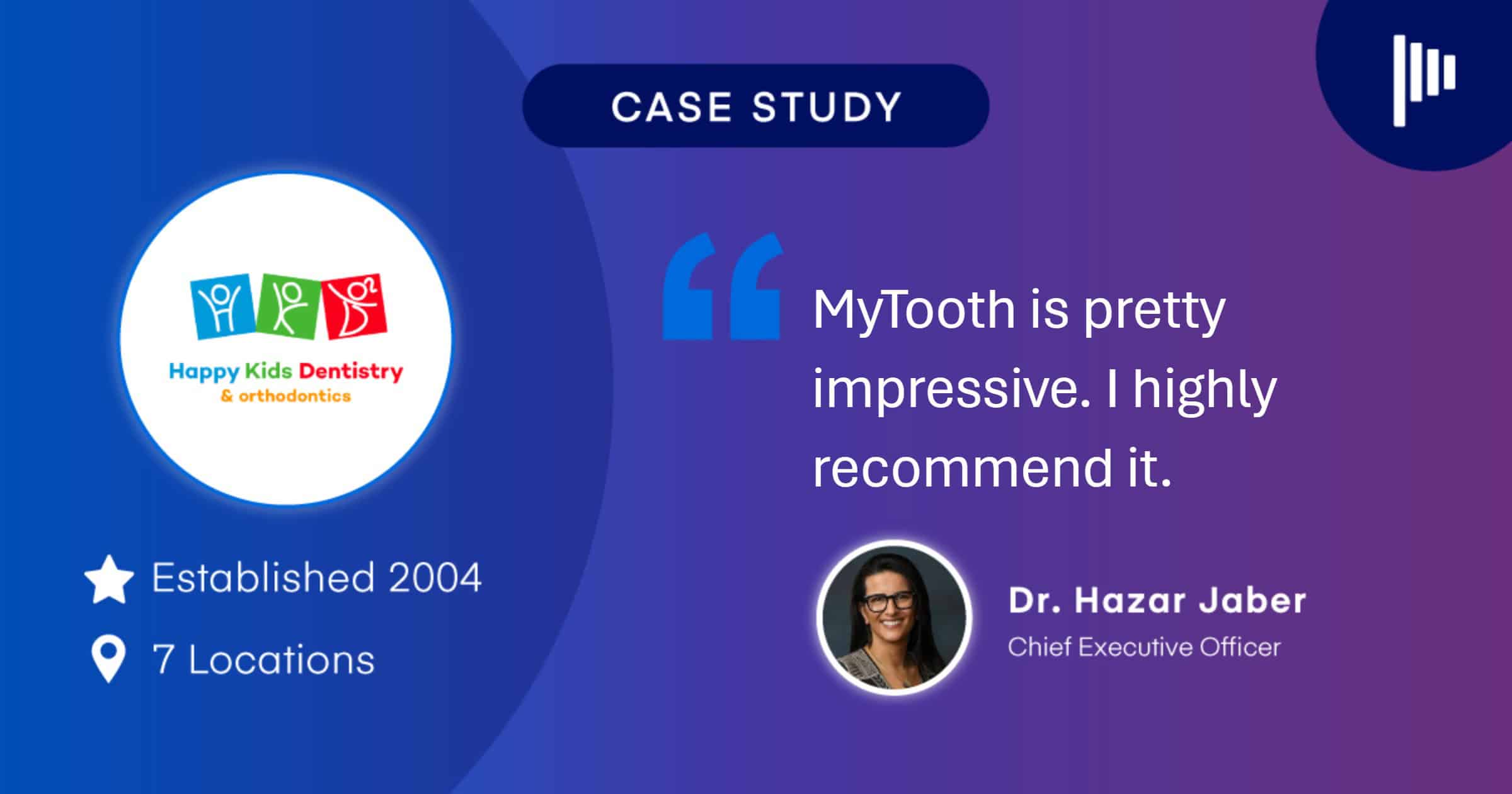
Happy Kids Dentistry & Orthodontics is a pediatric dental group with seven locations across Washington State. Across the group, Happy Kids Dentistry sees an estimated 8,000 patients a month, with each location averaging 300 to 400 patients on a typical day.
That pace is well above the industry norm: A recent American Dental Association (ADA) of dental practice puts the average U.S. dentist at roughly 3,742 patient visits per year, or about 310 per month. Even accounting for Happy Kids Dentistry’s larger footprint, sustaining that volume across seven locations simultaneously—without the manual matching and account-building most practices rely on—was the core operational challenge MyTooth had to solve.
“MyTooth has been great,” said Dr. Hazar Jaber, CEO of Happy Kids Dentistry. “We serve a lot of kids in our community.”
Once the workflow was right, adoption was immediate and heavy, quickly making Happy Kids Dentistry one of Denticon’s largest MyTooth users by volume.
“We moved everyone onto it, and we sent 50,000 forms through it in one month,” said Dr. Jaber. “So we quickly became heavy users of MyTooth.”
By comparison, a typical single-location dental practice processes an estimated 4,000 to 5,500 patient forms across an entire year (based on ADA visit data and standard intake-form volume). Happy Kids Dentistry moved 50,000 forms through the system in a single month during rollout, a volume that would take a typical solo practice roughly a decade to reach.
Replacing Manual Matching and Paper Questionnaires
Before MyTooth, Happy Kids Dentistry’s intake process—like that of many high-volume practices—relied on a chain of manual steps between a form being completed and that information actually reaching the patient’s chart.
Years earlier, Happy Kids Dentistry used a separate third-party texting and forms tool. Even after moving to Denticon, completed forms still had to be manually reviewed and matched to the correct patient account, a meaningful burden at a practice seeing hundreds of patients a day.
“There was a lot of paperwork,” said Dr. Jaber. “At Happy Kids, we are seeing hundreds of patients across our locations each day. So things need to not be manual. You don’t want to have to hunt for things for each patient.”
New patient intake carried an even heavier lift. For years, new patient calls were logged on paper as a new patient questionnaire (NPQ), then manually entered into the practice management system to create an account.
“What’s your name? What’s your phone number? What’s your dad’s name? What’s the insurance?” said Dr. Jaber. “Every day we see up to fifteen new patients in the practice. Those phone calls were all coming to our phone center, and they were taking the calls and filling in this data. These sheets need to be entered into the software to create the account and to create the appointment. It’s insanely time consuming and just not possible to maintain.”
To eliminate those manual steps, Happy Kids Dentistry turned to MyTooth, Planet DDS’s mobile-first patient experience solution built natively for Denticon. Patients complete digital forms, book appointments online, and upload documents from any device, and every update is written back to Denticon’s live data in real time, with no re-keying or syncing delays.
Building a Pediatric-First Intake Model at Family Kids
For an adult dental practice, the patient and the account holder are usually the same person. Pediatric dentistry is different: The patient is a child, but a parent or guardian is the one completing and signing forms. When Happy Kids Dentistry raised that request, the engineering team at Planet DDS listened, engaging directly with Dr. Jaber to understand the problem and refine a guardian-aware intake model for pediatric practices.
Dr. Jaber contrasted that responsiveness with her experience elsewhere in the industry, where vendors often treat their products as fixed, however well or poorly they fit a practice.
“It works if it’s three patients, but it doesn’t work if you have hundreds of patients,” said Dr. Jaber. “But with Denticon at Planet DDS, I really love that they listen. They work with us and say, ‘Oh, it doesn’t work? Let me go fix it and talk to the builder,’ or the coder or the engineer,’ to actually dig deeper.”
Because Denticon’s team took that feedback seriously, issues got resolved quickly, even at Happy Kids Dentistry’s scale. What stood out to Dr. Jaber wasn’t just that issues got fixed; it was feeling genuinely heard in the process.
“They were respectful of people’s input,” said Dr. Jaber. “They understood that I was providing input to make MyTooth even better.”
Creating an Invisible Front-Desk Workflow
With the mapping fully built out, front-desk staff no longer need to open, review, or re-key patient forms at all. Every piece of form data flows automatically into the correct fields of the patient record, while configuration options such as field locking and sibling and duplicate-account detection protect data integrity at Happy Kids Dentistry’s volume.
“From now on, you don’t have to click, you don’t have to open folders, you don’t have to open files, you don’t have to copy paste,” said Dr. Jaber. “It’s already mapped in. … My goal was nobody opening and looking. Every piece of information in the form now spits out correctly in the right space inside of the account, so we don’t need to.”
That shift changed what training even looked like for new staff. Instead of teaching new hires a checklist of manual steps, Happy Kids Dentistry now teaches them which steps no longer exist.
“The training is almost the opposite,” explained Dr. Jaber. “It’s like we’re trying to tell them, ‘You don’t need to do that,’ instead of, ‘You need to do this.’ … If you filled it, it’s already inside. We don’t have to open it. We don’t have to check it.”
Measuring Time Savings at Real Scale
The impact shows up first in existing-patient form processing. Before MyTooth, staff spent roughly two minutes manually entering each returning patient’s information as they came in.
“So it’s about 10 hours saved, at least [per day, across locations], if we see 300 patients,” said Dr. Jaber.
New patient onboarding, previously the most manual part of the process, changed even more dramatically. Pulling up several months of internal data, Dr. Jaber noted that setting up a single account the old-fashioned way took at least ten minutes.
“That’s about 26 hours to set up these 322 patients per month,” said Dr. Jaber. “Maybe double that if it’s fully manual. And then it’s nothing right now.”
That new-patient volume, roughly 46 per location per month, tracks almost exactly with the Planet DDS network average of 47 new patients per month per practice (Planet DDS 2026 Mid-Year Dental
Industry Outlook, based on 5,200 general and specialty practices on Denticon). In other words, Happy Kids Dentistry wasn’t dealing with an unusually high new-patient rate; it was handling an ordinary rate across seven locations at once—and doing it entirely by hand.
That change is also reflected in what actually gets created at the moment of booking. Where Denticon’s earlier online booking created a placeholder appointment, MyTooth now creates a complete, real patient account instantly.
“Right now, where we stand today, when a mom makes an appointment, the next step she could be seeing is the dentist,” said Dr. Jaber. “No staff have to interfere. The only time staff interferes is the insurance. The account is created, the forms fill the right spaces of the right places, and it’s definitely massively better.”
That reliability shows up in the numbers, too. Since launch, Happy Kids Dentistry has sent over 80,000 forms through MyTooth, and of the forms patients have actively engaged with, 98.2% have been completed and submitted, with the remainder still moving through the pipeline.
Freeing Teams for More Meaningful Work
With manual matching and account-building largely eliminated, Happy Kids Dentistry redirected staff time toward higher-value, patient-facing work.
“The team was surprised how their work has become less manual,” said Dr. Jaber. “Now they can think about things like, let’s call on outstanding patients. Let’s actually do accounts that have not been scheduled. Almost all of their job descriptions has changed. … They get to do less mind-numbing work and more of creative work, more of follow-up work, and take care of patients.”
For Dr. Jaber, that shift connects directly to how Happy Kids Dentistry thinks about its people—and, ultimately, its patients.
“At Happy Kids, we say we want our team to be happy, kind, open-minded, and dedicated,” said Dr. Jaber. “If you give them things that are more interesting, more exciting, more engaging—because we are changing kids’ lives—then my employees are going to be better, happier, more interactive, and that reflects on my patients.”
Preparing for a Successful MyTooth Rollout
For any Denticon customer not yet on MyTooth, Dr. Jaber’s advice centers on preparation, and on being willing to rethink existing workflows rather than simply digitizing old ones.
“Spend time in setting it up correctly to work to your workflow, number one,” said Dr. Jaber. “Number two is actually reconsider your workflow. That’s the hardest part. You need to really consider what the tool can give you and reconsider your workflow. Don’t take it live until all those details are worked out. But once you do, MyTooth is really pretty impressive. I highly recommend it.”
Build a Scalable Patient Intake Experience with MyTooth
For Happy Kids Dentistry, implementing MyTooth eliminated manual matching and account-building across seven locations while giving a high-volume pediatric group a direct voice in how the product evolved. By bringing digital forms, online booking, and patient account creation into a single Denticon-native workflow, the organization reduced manual work at scale and helped shape a pediatric-first intake model that now benefits every practice on Denticon.
Happy Kids Dentistry didn’t just adopt MyTooth; they moved their entire seven-location, 8,000-patient-a-month operation onto it at once, putting them well ahead of where most of the industry currently stands.
Looking to eliminate manual matching and scale patient onboarding across your organization? Contact us today.