DentalOS®: Built for the Dental Enterprise Era
For most of its history, dentistry was a practice business. Each location operated independently, with its own systems, workflows, and way of doing things. That model made sense when growth meant opening one more location or hiring one more provider.
Over the last decade, private equity investment accelerated consolidation across the industry, transforming independent practices into regional groups, dental support organizations (DSOs), and enterprise-scale organizations.
An estimated 150 to 300 DSOs now affiliate with 20 to 25 percent of all dental practices in the United States, while the largest organizations have nearly doubled their location counts in less than a decade.
That era produced extraordinary scale. It did not produce the infrastructure to run it. The acquisition phase succeeded. The dental enterprise operating phase is what is coming next.
The challenge facing DSOs and dental leaders today is no longer simply how to grow. It is how to operate what they have already built with visibility across the enterprise, consistent workflows across locations, and technology that compounds in value rather than complexity.
The Dental Enterprise Era: Why the Industry Has Reached a Turning Point
The last decade rewarded growth. Organizations acquired practices, entered new markets, added specialties, and expanded their geographic footprint. Technology decisions often followed behind—infrastructure could be addressed later—and standardization could come after the next acquisition.
That conversation has shifted. “Five years ago, it was growth,” said Mike Huffaker, chief revenue officer at Planet DDS. “How do we add locations? How do we get bigger? Today it is performance.”
These three forces are changing the timeline for every dental enterprise:
The performance imperative
Capital partners are no longer measuring how many locations a group can add. They are measuring how much performance a group can drive from the locations it already has.
Same-store growth is the new scoreboard. You don’t manufacture it with another acquisition; you build the operational foundation that produces it with consistency across every location in the portfolio.
AI and the data layer
New AI capabilities are emerging across scheduling, documentation, imaging, patient engagement, and revenue cycle management (RCM). Yet the value of those tools depends on something many organizations overlook: the quality of the data beneath them.
In 2026, the American Dental Association (ADA) named data interoperability, accessibility, and governance at scale as the biggest barriers to AI in dentistry.
For organizations operating on fragmented technology stacks, AI often exposes existing infrastructure challenges rather than solving them.
“AI is only as powerful as the data underneath it. Groups running on connected infrastructure will get dramatically more value from every AI tool they adopt.” —Mike Huffaker, Chief Revenue Officer, Planet DDS
The labor reality
Labor pressures are creating additional urgency. An estimated 70 to 90 percent of dental offices finds hiring hygienists and assistants very or extremely challenging, with fewer than half of open roles being filled.
The ADA Health Policy Institute reports that only about 60 percent of dentists have adequate hygiene staffing, with staffing ranking among their top challenges in 2026.
For many organizations, hiring alone is no longer a sustainable answer. The ability to standardize workflows and reduce operational discourse is increasingly a competitive advantage.
What Is Holding DSOs and Dental Groups Back?
For many DSOs and dental groups, it isn’t a lack of ambition or opportunity. It’s infrastructure. The growth strategies that helped organizations scale often left behind a patchwork of systems, workflows, and processes that were never designed to operate as a single enterprise.
The infrastructure gap
Across the industry, leadership teams are discovering that they have outgrown the infrastructure supporting their organizations: a different PMS in three locations, a separate imaging system that doesn’t share patient data, or an RCM workflow living in a spreadsheet built in 2019. The groups that went on acquisition runs are now sitting on the infrastructure decisions they deferred.
Now they are left with multiple systems that don’t talk to each other, technology spent where no one has full visibility, and locations that each operate differently because of fragmented processes.
“The PMS is not the destination. It is the foundation. The industry had spent twenty years building tools for the practice while the enterprise—the actual operating entity that needed visibility, control, and performance across dozens or hundreds of locations—was building on top of software that was never designed for it.” —Nathan James, Chief Product Officer, Planet DDS
The cost of process debt
Just as financial debt accumulates interest over time, debt compounds as organizations grow. Every manual handoff between systems, every duplicate workflow, and every spreadsheet created to bridge a technology gap introduces additional complexity.
Most DSOs and dental groups manage between five and fifteen disconnect systems across practice management, imaging, billing, payments, patient engagement, and reporting. This results in a revenue leak, data inconsistency, or staff-hour loss.
“We have a name for that cost. We call it process debt. And like all debt, it compounds. Silently. Until it doesn’t.” —Eric Giesecke, Chief Executive Officer, Planet DDS
Building a New Dental Enterprise Platform
The technology conversation started and ended with the practice management system: Which one? How does it integrate? What does it cost? Those were the right questions when most dental organizations were running one location or a handful.
They are the wrong questions for a dental enterprise.
A dental enterprise platform is something different. It is the connected infrastructure layer that sits beneath every clinical, financial, and operational workflow across a multi-location organization.
It connects practice management, imaging, payments, revenue cycle, and AI, so the organization runs as a single enterprise rather than a collection of separate practices.
“I’ve never met a DSO leader who said their biggest problem was finding the right practice management software. They talk about visibility, scale, AI, and operational consistency across dozens of locations. They’re looking for a platform that matches the ambition of what they’ve built.” —Mike Huffaker, Chief Revenue Officer, Planet DDS
What Is DentalOS®?
The era of dental enterprise demands a new kind of infrastructure. DentalOS® is that connected dental platform—the infrastructure layer that multi-location dental organizations run on, distinct from any individual practice management software, imaging tool, or AI point solution.
It is not a product that lives within a platform. It is the platform.
“How do you give a DSO leader complete visibility and control over their entire enterprise—from the front desk to the board room—on a single platform they actually own?” James said. “That is what DentalOS is built to do.”
DentalOS delivers a complete enterprise operating model through integrated layers. They work together from day one—not bolted together over time.
Open by design
Planet DDS made a bet that most software vendors wouldn’t make. Great dental enterprises should run the best tools in the industry, and those tools should work together natively without forcing a workaround or adding a vendor.
With more than eighty integration partners and open APIs, DentalOS gives operators control over their technology ecosystem without being locked into anyone’s roadmap.
Open architecture is not a technical preference; it’s a belief about who should be in control of how an enterprise operates.
“Every bet we’ve made as a company, we made early and often alone. Cloud-native before it was obvious, open ecosystem to give our customers choices, and enterprise-grade before DSOs were a mainstream conversation. It was never luck or prophecy. Our customers knew and we had the conviction to listen. DentalOS is our answer to the dental enterprise era.” —Eric Giesecke, Chief Executive Officer, Planet DDS
AI-native, not AI-added
DentalOS has woven AI into the data layer of the platform: inside the chart, workflow, and decisions teams make every day.
As a dental enterprise runs on DentalOS, the data underneath gets richer and more connected. That intelligence is an asset that belongs to the organization running on it. And unlike most assets, it compounds the longer you hold it.
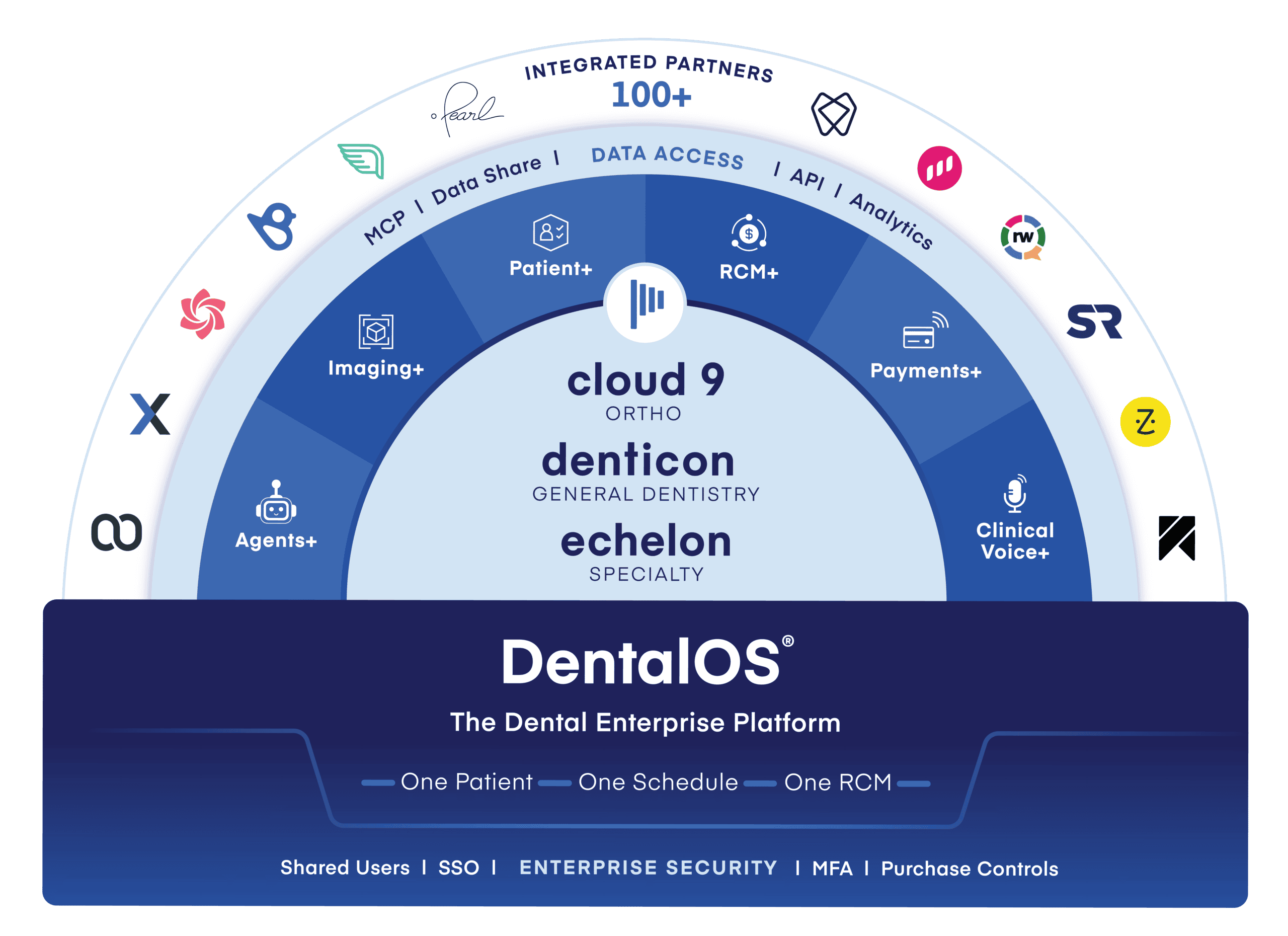
DentalOS: One Platform, One Data Layer
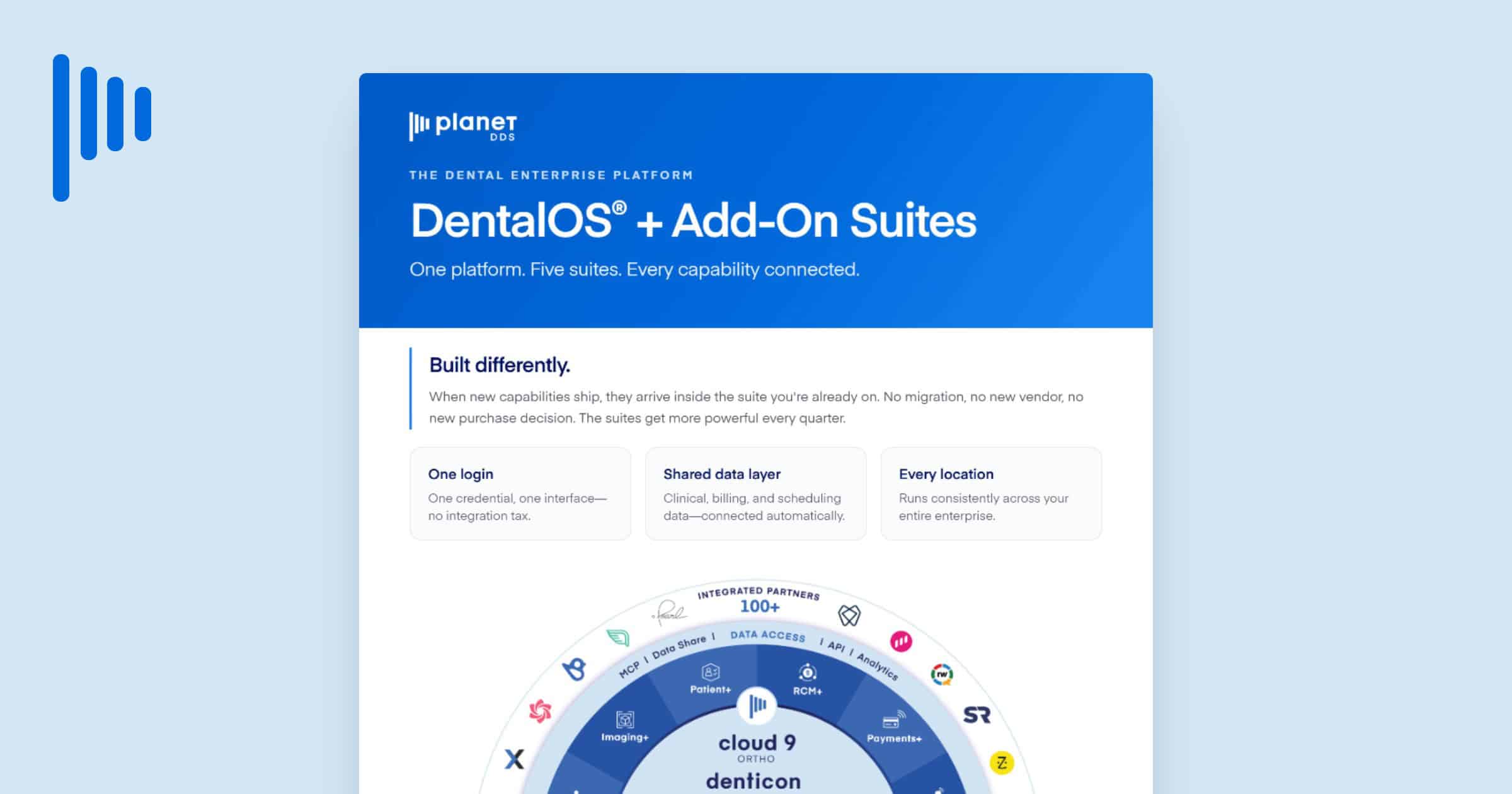
DentalOS connects practice management, revenue cycle, imaging, and AI on a single data layer. On that foundation is a new layer of enterprise add-on suites, each solving specific operational problems at scale.
- Agents+: Expands operational capacity without adding headcount. The Confirmation Agent automatically confirms appointments and updates the schedule; the Recall Agent identifies overdue patients and reaches out to book recall appointments.
- Clinical Voice+: Standardizes clinical documentation at the point of capture so DSO leadership can benchmark, govern, and trust clinical data across every provider and location; includes AI Voice Perio and AI Voice Restorative in Denticon.
- Imaging+: Removes per-location server infrastructure and gives enterprise leadership an organization-wide view of imaging utilization; includes 3D module, CBCT cloud storage, expanded storage, and imaging analytics.
- Patient+: Turns patient communication from a staff-dependent task into a systematic revenue process; includes MyTooth for a connected patient digital experience across scheduling, forms, and communication.
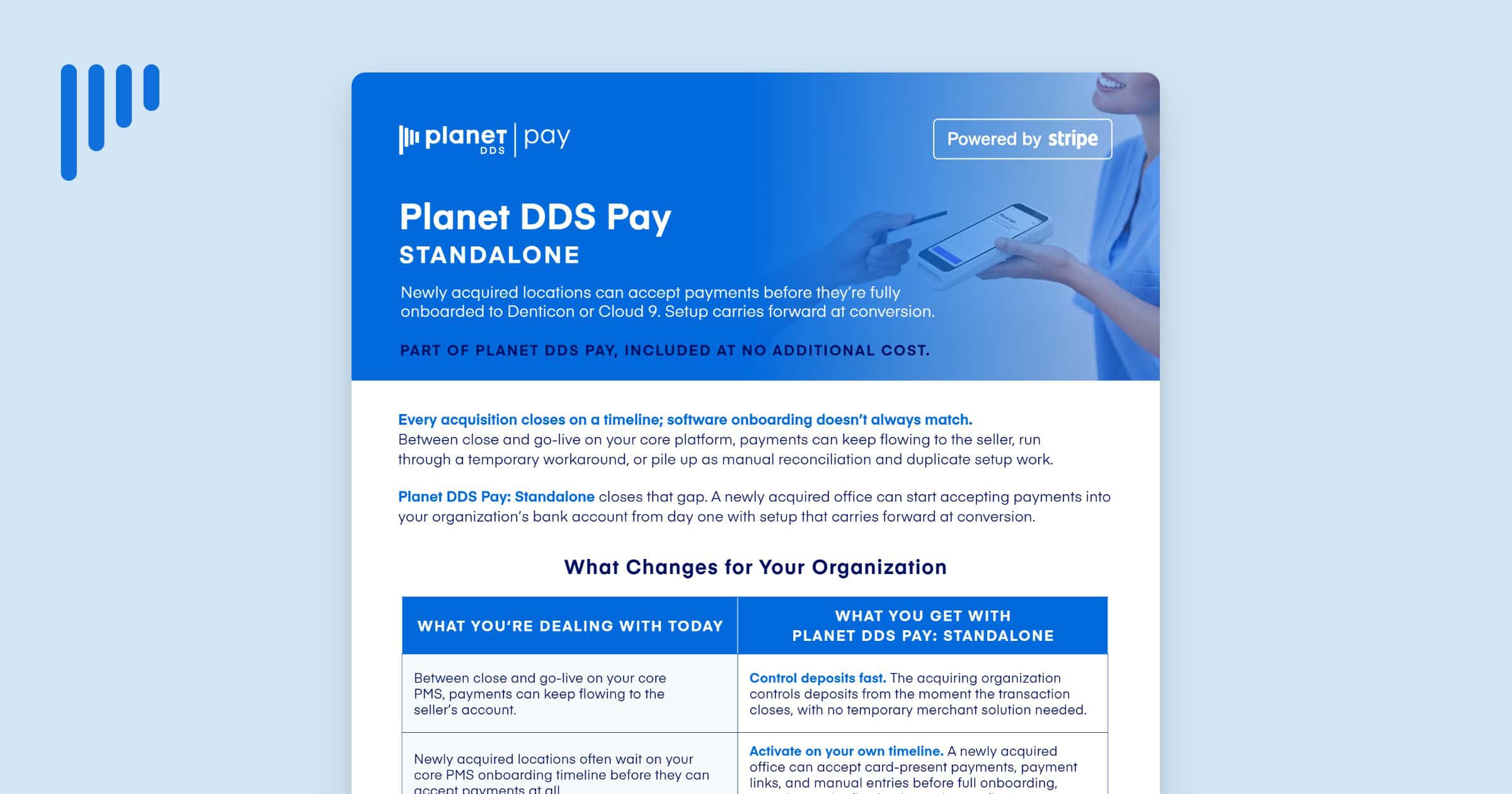
- Payments+: Closes the gap between collecting a payment and recording it; includes Planet DDS Pay for automatic ledger posting at the moment of collection across every location.
- RCM+: 20 to 30% of submitted claims sit in denial or pending at any given time. For a twenty-provider group, that’s millions in recoverable revenue. The RCM Hub changes that—purpose-built for revenue cycle within DentalOS, not as an afterthought inside practice management, surfacing that risk before it becomes a write-off across eligibility, claims, remittance, and patient AR.
“Every capability we’re building—AI agents, clinical voice, predictive revenue cycle—performs relative to the quality of the data beneath it. DentalOS is that foundational platform. We built the platform so that everything built on it today and in the future performs at a level disconnected tools never could.” —Nathan James, Chief Product Officer, Planet DDS
What Does DentalOS Mean for Organizations?
The platform decision is an infrastructure decision—and those decisions compound. Organizations that delay are not standing still. They are accumulating process debt with every acquisition and tool that underperforms on a fragmented stack.
For the organizations running on DentalOS, the picture looks different. Acquisitions onboard to a system rather than inheriting a fragmented stack. Workflows are consistent across every location. Leadership sees across the entire enterprise in real time, not in a spreadsheet.
And every year the platform is in place, the data underneath gets richer.
The compounding data advantage
Every day a dental organization operates, it generates information: clinical findings, scheduling patterns, revenue cycle activity, and patient engagement data. In fragmented environments, that information stays isolated.
Connected infrastructure changes that equation entirely. Every workflow, every interaction, and every operational outcome contribute to a growing intelligence asset that no late mover can manufacture retroactively.
“The organizations building something durable in this era are not waiting for a better moment. They are making the infrastructure decision deliberately while the window is open.” —Eric Giesecke, Chief Executive Officer, Planet DDS
Built for every stage of growth
This is not only a story about the largest DSOs. The dental enterprise era is defined by intent, not size.
A group that makes the right infrastructure at fifteen locations will be better positioned than a larger one in the future.
“A group that builds this foundation today will have an intelligence advantage in 2030 that a group starting later cannot close. That is not a marketing claim. That is the nature of data assets.” —Nathan James, Chief Product Officer, Planet DDS
DentalOS: The Dental Enterprise Platform Solution
The dental industry spent decades building software for the practice: tools for the clinician, the front desk, and the billing team. All necessary, but none designed to run an enterprise.
The organizations building something durable in the next phase of dental are not the ones with the most locations or the largest technology budgets. They are the ones creating operational leverage from their scale: connecting data, workflows, teams, and systems in ways that make every part of the organization stronger.
DentalOS is built to run the dental enterprise—not just the practice. Turn your tech stack from a cost center into a competitive asset.
Ready to see DentalOS in action? Contact us today.