From Missed Calls to More Visits: Patient Communication for DSOs and Dental Groups
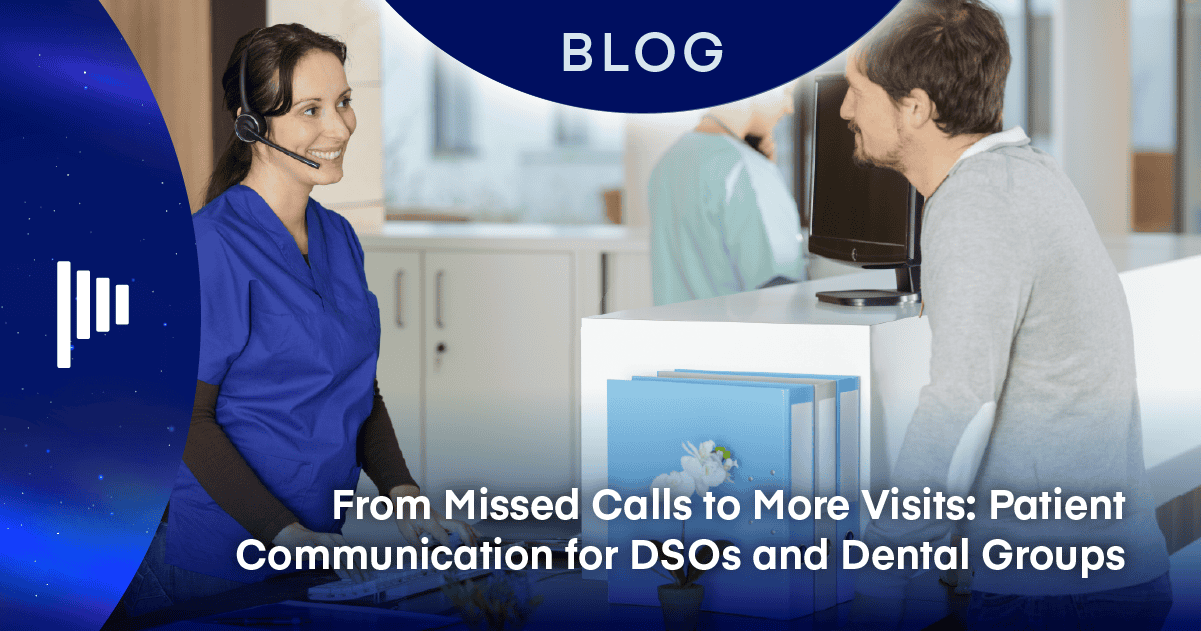
Patient communication is one of the few functions every location in a dental group is expected to run the same way, yet it still depends on whoever has a free minute at the front desk. Calls, confirmations, forms, recall, and follow-up all compete for the same team’s time.
According to Dental Economics, industry benchmarks show practices miss 30% to 38% of incoming calls during business hours, and the workload grows with every location a dental support organization (DSO) adds.
When that work slips, the gaps show up in the schedule. Confirmation calls get skipped, recall lists fall behind, and canceled appointments leave chairs empty.
Schedules are also less full. According to the ADA Health Policy Institute’s Q3 2026 State of the U.S. Dental Economy report, appointment wait times for new patients reached a new low in the third quarter of 2026, averaging twelve business days. Every call and every overdue patient now counts for more.
Find out how DSOs and dental groups can improve patient communication without adding staff, what to look for in dental practice management tools, and how Patient+ and Agents+ in DentalOS® Add-On Suites support patients before, during, and after every visit.
Why Is Patient Communication Harder to Manage at Multiple Locations?
Patient communication more difficult with each location because the same work multiplies while the team doing it stays stretched. Calls, confirmations, forms, and follow-up happen at every office, and small differences in how each one handles them become differences in how patients experience the group.
Patient expectations raise the bar, and a hard-to-use digital front door can cost a practice appointments. “Patients are not troubleshooting—they’re booking elsewhere,” said Eric Giesecke, chief executive officer at Planet DDS.
Cancellations add to the load. The Planet DDS 2026 Mid-Year Dental Industry Outlook found that 13.7% of patients canceled in advance in the first half of 2026, above the 2025 industry average. Scale strains operations too.
The 2026 Dental Industry Outlook: Deep Dive also found DSOs with 26 to 50 offices grew just 2.8%, less than one-third the rate of smaller DSOs, as systems that worked at 15 offices tend to buckle at 40.
How Can DSOs Improve Patient Communication Without Hiring More Staff?
DSOs can improve patient communication without hiring more staff by automating the repeatable work (calls, reminders, forms, and recall) and running it from the live schedule at every location. Team members then spend their time on conversations that need judgment and empathy.
Dentists are already moving in this direction. According to the ADA Health Policy Institute, among dentists planning to start using AI, front desk functions such as check-in and appointment scheduling tools are among the top intentions for 2026.
The Dental Economics–Levin Group survey found that 22% of practices cited difficulty hiring administrative team members, an improvement that Dr. Roger Levin, chief executive officer and founder of Levin Group, said could result from more automation of those tasks.
The shortage reaches clinical roles where hiring is no quick fix for growing workloads. “When 70 to 90 percent of dental offices report they cannot fill clinical roles, you cannot hire your way to performance,” said Giesecke. “Automation is no longer a productivity story. It is a survival one.”
Practical ways to apply that approach include:
- Answer every inbound call, including after-hours and overflow calls.
- Confirm appointments through automated outreach that patients can answer.
- Let patients schedule, reschedule, and complete forms from any device.
- Follow up after cancellations and missed visits.
- Run recall outreach on set protocols, including nights and weekends
- Set communication rules once and apply them across all locations.
Each of these best practices works best when it runs from the live schedule and patient record rather than a separate copy and when corporate teams control the rules centrally.
Which Dental Practice Management Tools Offer the Best Patient Communication?
The best patient communication tools for DSOs and dental groups are native to the practice management system, so they work from the live schedule and patient record. For multi-location organizations, they also need central controls that apply consistent rules at every office.
Groups evaluating patient communication tools should look for:
- Live schedule access, so bookings and messages reflect changes immediately
- Real-time write-back to the patient record, with no manual entry
- Central settings and templates that apply at every location
- Consent controls and audit trails that support compliance
- Self-service and automated options that reduce front desk workload
Many patient communication products sit outside the practice management system and work from a synced copy of the schedule, which can lag behind changes. Tools built into the system avoid that gap.
Leaders are holding technology to a higher standard. “Today’s DSO leaders are evaluating technology the way enterprises evaluate platforms: single data layer, security governance at scale, and real visibility across every location,” said Giesecke.
DentalOS Add-On Suites take that native approach. The five suites run on the same data layer, security model, and login that teams already use, with Patient+ and Agents+ supporting patient engagement:
- Patient+: Online scheduling, digital intake and consent, two-way messaging, and automated reminders and recall for Denticon and Cloud 9 locations
- Agents+: AI agents built into Denticon that answer inbound calls and place outbound calls to confirm, recall, and rebook patients
Patient+ and Agents+ provide continuous patient communication from the first call or booking through follow-up after every visit.
How Does the Patient+ Suite Improve Patient Communication?
Patient+ turns patient communication from a staff-dependent task into a systematic process that runs on the live schedule and creates the same experience at every location. It covers scheduling, intake, messaging, and recall in one suite for Denticon and Cloud 9 locations.
Online scheduling
Patients book through self-service scheduling that syncs live to provider calendars in Denticon or to chair and operatory availability in Cloud 9. The link opens on any device with no app to download, supports English and Spanish, and can carry each location’s branding. That captures appointments that would otherwise be missed after hours or while phones are busy, and it reduces call volume.
Booking also creates a complete patient account instead of a placeholder appointment, so the front desk is not left to build it manually. For a pediatric group seeing hundreds of patients a day, that is the difference between a booking that needs follow-up and one that is ready to go.
“Right now, where we stand today, when a mom makes an appointment, the next step she could be seeing is the dentist,” said Dr. Hazar Jaber, chief executive officer at Happy Kids Dentistry. “No staff have to interfere. The only time staff interferes is the insurance. The account is created, the forms fill the right spaces of the right places, and it’s definitely massively better.”
Digital intake and consent
Intake, consent, and medical history are completed before the patient arrives, and each entry updates the record in real time. For Denticon locations, corporate teams set approved templates that new locations inherit, so every office collects the same information.
The volume involved can be significant. Happy Kids Dentistry sent 50,000 forms through Patient+ in a single month during rollout, and the group estimates the change saves about ten hours of returning-patient data entry a day across its seven locations. Before the change, staff had to match each completed form to a patient account by hand.
“There was a lot of paperwork,” said Jaber. “At Happy Kids, we are seeing hundreds of patients across our locations each day. So things need to not be manual. You don’t want to have to hunt for things for each patient.”
Two-way messaging, reminders, and recall
Patients confirm, cancel, or reschedule by replying to text and email messages, so those changes happen without front desk involvement. Reminders, confirmations, and recall outreach follow each practice’s protocols, and recall runs automatically on active treatment and hygiene schedules. Because messages run on the live schedule, the calendar updates right away when a patient reschedules.
These tools are easy to pick up because they work inside Denticon. For CaliDental, the team was able to use Patient+ right away, with no separate logins to manage.
“You set up one time, and you forget about it,” said Randa Seif, chief operating officer at CaliDental. At about 200 new patients per location each month, CaliDental estimates digital intake saves 67 to 100 staff hours monthly per location.
How Does the Agents+ Suite Support Patient Communication?
Agents+ puts AI agents inside Denticon to handle the high-volume calls that multiply with every location. The agents work from the same live schedule and patient record as the team and write outcomes back in real time.
Tone, timing, and escalation settings are configured centrally, so patients get the same experience on every call and agent activity appears in existing DentalOS reporting. Patient information stays protected throughout, since the agents are HIPAA-safe by design, and Planet DDS is SOC 2 Type 2 certified.
Patients also see the result right away. When an agent confirms or reschedules a visit, the calendar updates automatically.
“Every outcome writes back to Denticon in real time,” said Seif. “Not through a sync, not through a middleware layer, but directly into the same data the practice already runs on. What the agent does at 9 a.m. shows up in Denticon at 9 a.m.”
AI Receptionist for inbound calls
The AI Receptionist answers every inbound call across locations, day or night, in English or Spanish. It books and reschedules appointments, answers common questions, and handles new-patient intake and triggers intake paperwork to the patient.
When a person is needed, it warm-transfers the call to staff with an AI-generated summary, so the team has context, and emergencies or trauma are transferred immediately.
Confirmation Agent for outbound outreach
The Confirmation Agent places outbound calls within a configurable window, confirms the appointment, and offers a new time in the same call when a patient cannot attend. It verifies identity before sharing protected health information, respects consent and office hours, and writes back each outcome to Denticon.
CaliDental’s results show what this looks like in practice. In ninety days at four locations, the Confirmation Agent confirmed 5,865 appointments without a manual call, handled the equivalent of 387 staff hours of outbound calling, and escalated only 0.7% of calls to staff. Every interaction was logged with a full audit trail.
Recall Agent for overdue patients
The Recall Agent finds overdue patients in the live record and calls them on the practice’s protocol, including nights and weekends. It speaks English and Spanish, switches languages mid-call, and caps call attempts so patients are not over-contacted.
When a patient is ready, it books the visit directly into the schedule. Recall then runs as a dependable workflow instead of a list the front desk works through when time allows.
Cancellation Rescheduling Agent for canceled appointments
The Cancellation Rescheduling Agent works Denticon’s nightly cancellation list and waitlist, calling patients who canceled to offer a new time. It reads the practice’s cancellation policy before offering to reschedule, and once a patient accepts, the new appointment writes back to Denticon right away.
Missed Appointment Rescheduling Agent for no-shows
The Missed Appointment Rescheduling Agent follows up the same night with a warm, low-pressure call that acknowledges the missed visit and offers a new time. It flags any emergency for staff while pausing automated outreach, and it books accepted appointments directly into the schedule.
For Seif, the biggest benefit is consistency at every location: “The real value of an AI Agent is its ability to deliver consistent, repeatable execution at scale. Once properly trained and configured, AI follows established processes reliably, reduces human variability, and ensures that critical steps are performed consistently without relying on someone to remember every detail.”
How Can Dental Groups Increase Patient Retention?
DSOs and dental groups improve patient retention by reaching every patient at the right moments: before a visit, after a cancellation, and when recall or treatment is due. The patient engagement tools that do this best sit inside the same system that holds the schedule, so outreach never depends on someone remembering to start it.
Return visits show where follow-through falls short. The Mid-Year Outlook report found a 66% hygiene reappointment rate in the first half of 2026, up from 63% in 2025, and a 49% average case completion rate, up from 47%. That means roughly half of the care patients agree to is still not completed.
“The revenue isn’t being lost at the treatment planning conversation; it’s leaking in the space between yes and actually getting the work done,” said Mike Huffaker, chief revenue officer at Planet DDS.
Patient+ keeps patients engaged between visits with reminders, two-way messaging, and automated recall for individual offices. Agents+ reaches patients by phone through the Recall Agent and Rescheduling Agents when a visit is overdue, canceled, or missed. Both suites run on the live schedule, so outreach reflects what is actually on the calendar. Tracking reappointment and case completion by location shows which offices need attention first.
Strengthen Patient Communication Across Every Location
DSOs and dental groups can improve patient communication by automating routine calls, reminders, forms, and recall, running them from the live schedule, and applying the same rules at every location. Done well, patients are reached before and after every visit while teams stay focused on the people in front of them.
Start by finding where engagement breaks down at each location, whether that is unanswered calls, unconfirmed visits, paper forms, or overdue recall, and close the largest gaps first.
Explore DentalOS Add-On Suites to see how Patient+ and Agents+ support patient communication for your organization.