The 2026 Orthodontic Practice Management Solution Buyer’s Guide for OSOs and Ortho Groups
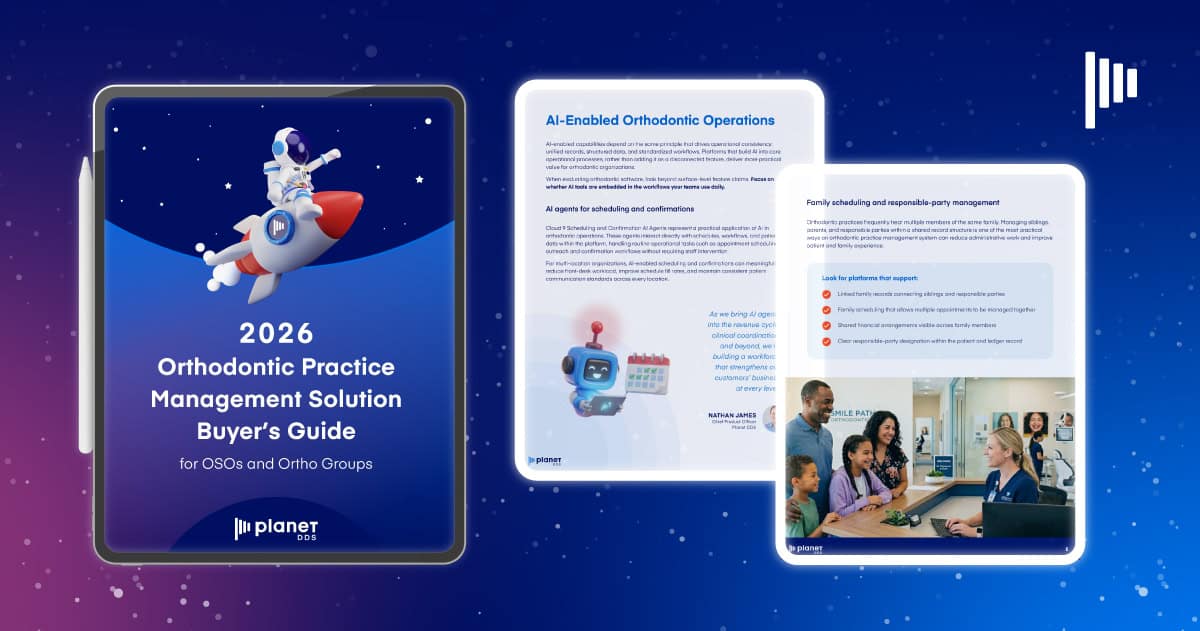
Orthodontic organizations have invested heavily in technology, but consistent execution across locations remains a challenge. As patient volumes grow and operations expand, leadership teams need platforms that bring visibility, standardization, and control into a single system.
This guide breaks down how to evaluate orthodontic practice management software through an enterprise lens, focusing on the capabilities that support consistent performance across consult workflows, scheduling, financial management, and AI-enabled operations.
Download the guide to see what modern orthodontic platforms should deliver and what to look for when evaluating your options.
The New Standard: Orthodontic Practice Management Software
Orthodontic software has moved well beyond server-based systems built for single-location practices. Cloud-based platforms now support multi-location access, real-time updates, and more connected workflows across the organization.
Even with those advancements, many orthodontic support organizations (OSOs) and ortho groups still experience gaps in visibility and consistency. Workflows vary by location, reporting often requires extra effort, and patient experiences can feel disconnected depending on where care is delivered. As organizations expand, those gaps become harder to manage.
The standard has shifted toward unified platforms like Cloud 9 that facilitate the full arc of care—from consultation through retention—while keeping execution aligned and measurable across locations.
What OSOs and Ortho Groups Should Prioritize
Most orthodontic groups are no longer evaluating software based on individual features. The focus has moved to how well the platform enables consistent execution across daily operations.
That includes consult workflows, recurring scheduling, treatment coordination, financial oversight, and AI-enabled processes that operate within the same system. The goal is to keep these workflows connected so teams can operate consistently across locations.
Automation is already playing a larger role in that transition. Many organizations are finding they can scale operations without adding staff, using automation to handle routine work while maintaining control over how workflows are executed.
Infrastructure and Scalability
As orthodontic groups expand, systems must scale without adding operational complexity. Cloud-native platforms provide centralized access, real-time reporting, and shared workflows across locations.
What matters most is continuity. Scheduling, treatment coordination, and financial activity should remain aligned as new locations are added so performance stays measurable without manual consolidation.
That consistency allows leadership to maintain real-time insights across locations without relying on disconnected systems, creating a foundation where growth doesn’t introduce new operational gaps.
Ortho Workflow Standardization and Treatment Coordination
In orthodontic operations, consistency often comes down to how workflows are structured. Small differences in consult intake, treatment coordination, or scheduling can create larger performance gaps over time.
Standardized workflows help close those gaps. From consult through treatment start and recurring adjustments, a consistent structure makes execution more predictable and easier to manage.
Automation reinforces that consistency when it’s built into the workflow. Many organizations are already seeing the impact, with the ability to scale operations without hiring additional staff while maintaining control over execution.
“Automation can help scale operations without hiring additional staff. With many already facing labor shortages, automation allows them to do more with less.” —Stephen Fong, CFO, Planet DDS
Patient Communication and Digital Forms
Orthodontic patient care relies on frequent, ongoing communication. Appointment reminders, confirmations, and follow-ups happen continuously throughout treatment, and managing that volume manually becomes difficult across multiple locations.
When communication tools sit outside the platform, teams often end up tracking conversations separately from patient records. Bringing those workflows into the same system keeps everything connected and easier to maintain.
For many teams, this shift has had a noticeable impact. Real-time messaging, automated reminders, and two-way texting improve both operational efficiency and the patient experience across locations.
“Cloud 9 Connect is an absolute game changer. The real-time patient communication, seamless appointment reminders, and the two-way texting feature have revolutionized our workflow.” —Dr. Larry Moray, Founder, MyOrthodontist
Revenue, Contracts, and Financial Controls
Orthodontic financial workflows are structured differently from general dentistry. Treatment is typically contracted upfront, with payments collected over time, requiring consistent tracking across the full duration of care.
As organizations expand, maintaining alignment in contract setup, payment plans, and reconciliation becomes more important. Even small inconsistencies across locations can affect reporting accuracy.
Managing revenue across multiple locations is often one of the biggest challenges. When payment collection, posting, and reconciliation are handled within the same platform, organizations can improve performance and maintain more consistent financial oversight.
“Managing payments and revenue across multiple locations is a significant challenge. Planet DDS Pay streamlines this process by accelerating payment collection, automating revenue cycle management, and enhancing both security and the patient experience.” —Eric Giesecke, CEO, Planet DDS
AI-Enabled Orthodontic Operations
AI is becoming part of orthodontic operations, particularly in areas tied to scheduling and patient communication. The most practical applications are those embedded directly into daily workflows.
Scheduling outreach, appointment confirmations, and routine communication can be handled within the system, reducing front-desk workload while maintaining consistency across locations.
Organizations are increasingly looking for AI that supports operational work without introducing additional steps. When embedded correctly, these tools help teams maintain consistency while reducing repetitive tasks, allowing staff to focus on higher-value work.
Choose a Modern Orthodontic Platform for Growth
OSOs and ortho groups are taking a closer look at how their systems perform as operations expand across locations. Consistency in scheduling, treatment coordination, and financial workflows is what keeps day-to-day operations on track.
Cloud-based infrastructure sets the baseline, but execution depends on how reliably those workflows operate together as your organization grows. As AI becomes more embedded in scheduling and patient communication, that consistency becomes even more important.
The right platform gives your leadership team a clearer view of performance and keeps teams operating in sync across every location, bringing greater control and efficiency into your operations.
Want to find out how Cloud 9 orthodontic practice management solutions can support scalable, standardized operations? Contact us to learn more.