Dr. Sameer Puri on Scaling Dental Practices Without Losing Clinical Autonomy
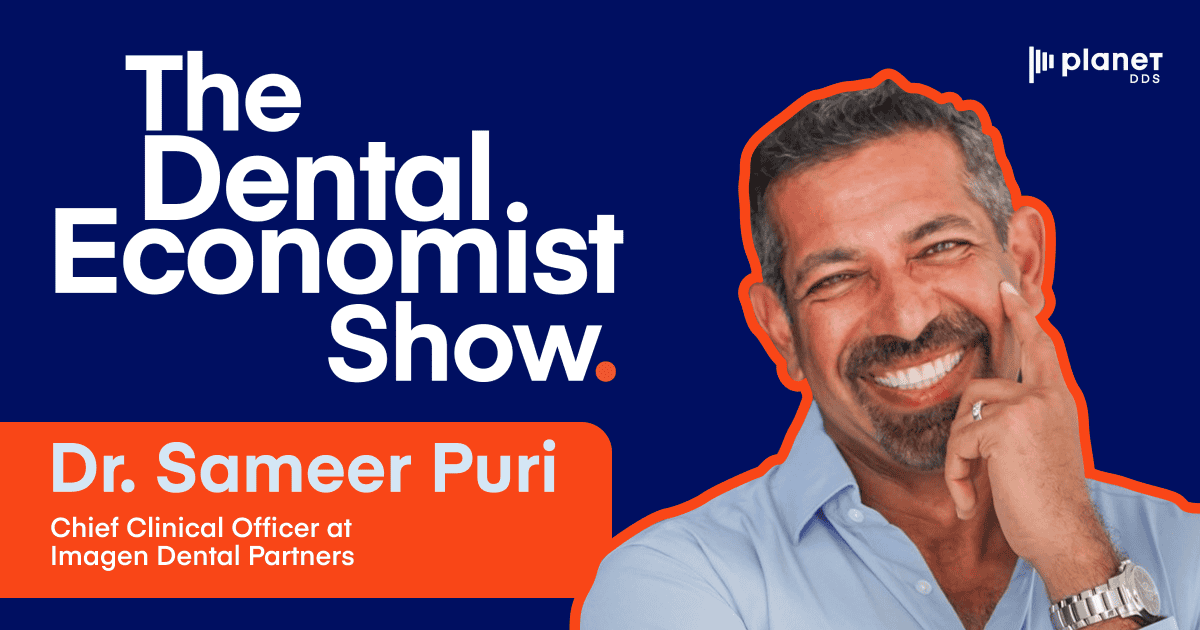
Have you ever wondered why some dental practices thrive after joining a dental support organization (DSO) while others struggle to grow? In the latest episode of The Dental Economist Show, host CRO Mike Huffaker of Planet DDS sits down with Dr. Sameer Puri, chief clinical officer at Imagen Dental Partners, to explore how education, leadership, and clinical autonomy shape dental business performance at scale.
What you’ll learn:
- How education can directly impact dental business performance
- Why leadership remains critical to dental practice growth after partnership
- How clinical autonomy and business systems can coexist inside a DSO
- What metrics matter when evaluating dental education and new services
- Red flags that signal poor dental partnership alignment
- How to reduce chairside hours without harming dental production
- Why core dentistry fundamentals still drive the strongest dental business results
- What keeps Dr. Puri optimistic about the future of dental businesses
Tune in for a conversation that traces all that’s happened and all that’s coming our way.
Episode Highlights
In this episode, host Mike Huffaker sits down with Dr. Sameer Puri for a practical conversation on what actually drives dental practice growth inside a DSO environment. Here are some highlights from the show:
Education without implementation becomes entertainment
Dr. Puri explains why most dental education fails to produce lasting change inside practices. Drawing from his experience building CDOCS and now leading education at Imagen Dental Partners, he argues that education only creates value when it changes behavior in the operatory. He breaks down how Imagen designs its internal workshops with one goal in mind, implementation that leads to better patient care and measurable growth.
Courses are tied to specific procedures, tracked through data, and evaluated over time. If a workshop does not result in increased adoption, improved outcomes, or real patient benefit, it is removed. This approach shifts education from a feel-good activity into a disciplined operating lever that directly impacts how a dental business performs.
Why leadership still determines dental practice performance after partnership
When practices underperform inside group models, Dr. Puri does not blame systems, branding, or structure. He points to leadership. He explains that some partners mistakenly assume growth becomes the organization’s responsibility once they affiliate, then reduce chairside hours or disengage from daily leadership. That mindset creates stagnation.
High performing practices continue to have an active leader who sets standards, shows up consistently, and owns outcomes. Tools and support help, but they do not replace leadership. Dr. Puri emphasizes that partnership works best when doctors maintain an owner mindset and treat the organization as an amplifier, not a substitute for accountability.
Clinical autonomy vs. business autonomy and why the line matters
Dr. Puri draws a clear and practical distinction between clinical autonomy and business autonomy. Clinical autonomy covers how care is delivered, procedures chosen, and treatment philosophy. That remains with the doctor. Business autonomy covers systems that allow the organization to function at scale, including technology platforms, reporting, and operational processes.
Confusing the two creates friction. Dr. Puri explains why some decisions, like standardizing practice management systems, must be nonnegotiable, while others, like lab choice or clinical approach, remain flexible. By keeping this boundary clear, Imagen avoids micromanagement while still building an efficient, scalable dental business.
Growth traps and why fundamentals still win in dentistry
Dr Puri challenges the idea that growth comes from chasing niche services or trendy add ons. He shares examples of practices that harmed performance by focusing too heavily on narrow offerings while neglecting core dentistry. His perspective is simple. Sustainable growth comes from strong exams, clear patient conversations, comprehensive treatment planning, and efficiency in everyday procedures like crowns, endo, and implants.
For associates, this means building a solid foundation before expanding scope. For partners, it means resisting distractions that pull attention away from what consistently drives patient care and revenue. Mastery of fundamentals, not constant reinvention, remains the most reliable growth strategy.
About The Dental Economist Show
Don’t miss insightful conversations with industry experts on the latest trends and top strategies to grow your DSO or dental group. Tune in to The Dental Economist Show each week as we meet at the intersection of profit and purpose.
Listen to the full podcast: