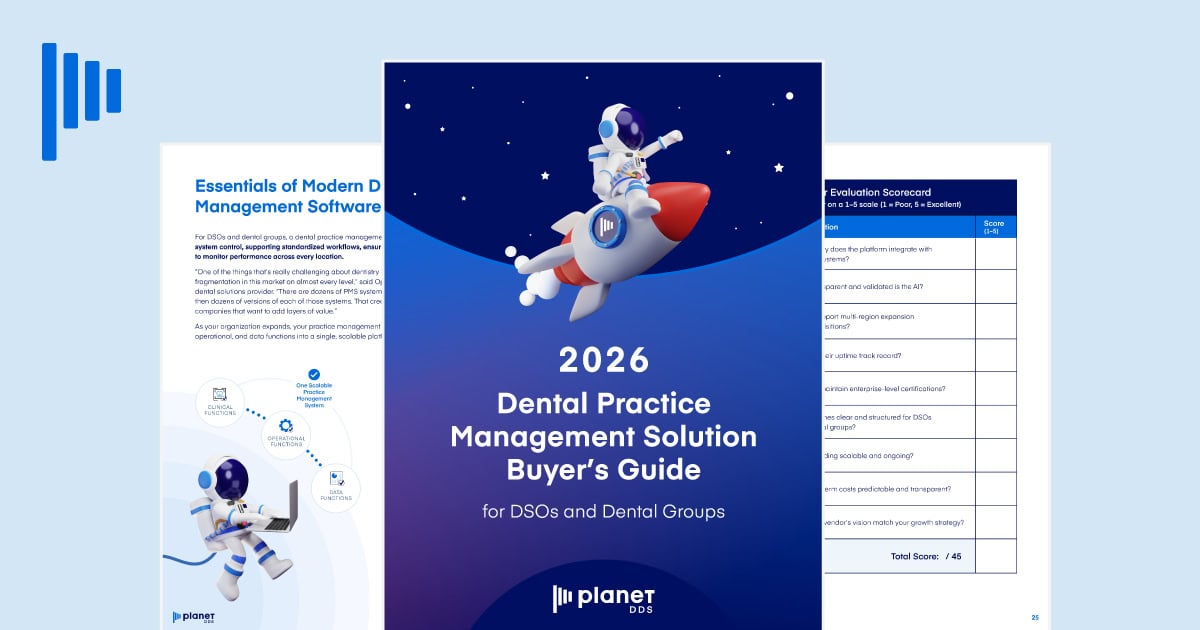
The 2026 Dental Practice Management Solution Buyer’s Guide for DSOs and Dental Groups
Dental practice management software is entering a new phase, shaped by the need to support dental support organizations (DSOs) and dental groups at scale. What began as a move from legacy dental software to cloud-based practice management systems has evolved into modern integrated platforms built to unify clinical, operational, and revenue workflows for multi-location organizations.
The global dental practice management software (PMS) market is projected to approach $5 billion by 2032, as cloud and integrated solutions continue to take hold. As DSOs and dental groups expand in size and complexity, systems that centralize data, standardize performance, and support multi-location operations are increasingly necessary to maintain consistency and scalability across organizations.
Modern dental platforms now bring together imaging, analytics, revenue cycle management (RCM), open APIs, and intelligent automation within a unified solution, raising new questions about how to evaluate software and plan for what comes next.
This buyer’s guide helps DSOs and dental groups understand what to look for as they assess dental practice management software and which capabilities matter most.
Before You Buy: Understanding Your Organization’s Needs
Technology decisions carry more weight when organizations are expanding, integrating new locations, or standardizing processes across regions. Aligning internally before evaluating vendors helps teams make more informed, lower-risk decisions. Key considerations include:
- Assessing operational maturity and identifying where manual processes create scale constraints
- Engaging key stakeholders early across operations, finance/RCM, clinical leadership, and IT/security
- Planning for growth and AI readiness so today’s decision supports future operating models
These steps help reduce implementation risks and ensure the platform supports enterprise priorities, not just feature-level preferences.
Essentials of Dental Practice Management Software
For DSOs and dental groups, practice management software should provide the operational structure needed to standardize workflows, maintain data integrity, and support enterprise-level visibility. A modern platform includes:
- Centralized cloud architecture built for multi-location scalability
- Embedded revenue workflows that reduce operational fragmentation
- Open APIs for extensibility and system integration
- Real-time analytics for cross-location visibility
- Integrated imaging and clinical documentation
- Enterprise security, governance, and uptime standards
- Patient engagement tools for modern scheduling and communication
These new capabilities stress why integration has become a priority for organizations managing multiple systems across locations.
Exploring Modern Dental Software Solutions
Dental practice management is increasingly defined by how well the broader technology stack works together. Connected solutions like Denticon by Planet DDS play a central role in supporting day-to-day performance and long-term scalability across multiple locations.
Cloud-based software: The foundation for growth
Cloud-based architecture supports consistency across locations by enabling centralized access, standardized updates, scalable infrastructure, secure remote work, and platform-level integration. A shared cloud environment also reduces infrastructure overhead and supports more predictable operations as organizations add locations or users.
Automated revenue cycle management
Revenue cycle management automation has become a core lever for improving consistency and reducing manual effort as volume increases, helping organizations manage eligibility, claims, and payments more predictably as operations scale.
The power of open APIs and connectivity
Open APIs support flexible technology environments by enabling third-party integrations, direct imaging connections, configurable workflows by location, and more consistent data alignment across systems. This enables organizations to extend functionality without disrupting core workflows or creating new data silos.
Enhanced analytics: Turning data into decisions
As organizations grow, analytics becomes essential for identifying trends and preventing drift across locations. Real-time dashboards, benchmarking, comparisons across sites and providers, and forecasting support for staffing and scheduling help leaders maintain visibility and make more informed decisions.
Artificial intelligence in modern dental platforms
The market for AI in dentistry is expected to surpass $3 million over the next decade, as adoption expands across diagnostics, imaging, automation, and revenue cycle operations. Practical applications are increasingly focused on improving consistency and reducing repetitive work through AI-assisted radiography, administrative automation, predictive insights, and emerging agent-based support models.
Patient engagement and communication
Patient engagement tools support retention and schedule utilization when communication is consistent and reliable. Integrated messaging, digital forms, reminders, and mobile-first scheduling help teams manage outreach efficiently while meeting patient expectations.
Imaging and clinical intelligence
Imaging remains one of the fastest-growing application areas for dental AI. Market analysts expect AI in dental imaging to expand from $1.3 million to more than $3 million by 2030, reinforcing imaging as a key driver of clinical standardization and documentation support across large organizations.
Security, compliance, and data protection
Multi-location organizations manage large volumes of PHI and financial data. IBM reports that the average healthcare data breach costs $742 million and takes 279 days to resolve. Modern dental platforms are expected to support secure workflows through strong access controls, auditability, encryption, and recovery readiness.
Building a connected dental operating system
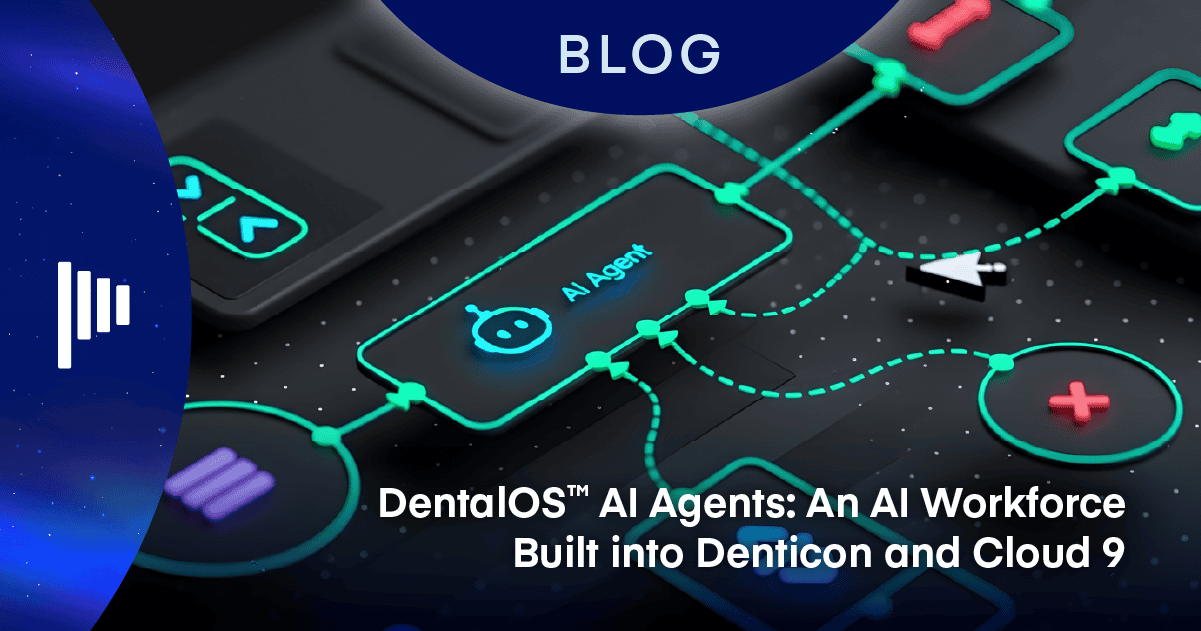
Disconnected systems create inefficiency and make it harder to operate predictably across locations. A connected DentalOS™ system with AI unifies clinical, operational, and revenue workflows, embedding AI directly into day-to-day processes and supporting extensibility through open APIs.
Evaluating Vendors: What to Ask and Expect
Vendor evaluation is most effective when questions are tied to scale, integration, and long-term partnerships. Clear criteria help DSOs and dental groups assess whether a platform is built to support multi-location operations over time. A strong evaluation should consider:
- Operating system vs. disconnected systems
- API depth and integration reality
- AI validation and governance
- Security posture and compliance readiness
- Implementation and support at scale
- Customer feedback and roadmap alignment
This approach helps teams assess whether a platform is built to support growth, consistency, and operational alignment over the long term.
The Next Chapter of Dental Practice Management
Cloud platforms, open APIs, analytics, and AI are pushing dental practice management toward connected operating systems designed for scale. DSOs and dental groups that centralize workflows and adopt platform-level intelligence are better positioned to support consistency, reduce manual work, and improve financial performance across locations.
Want to find out how Denticon dental practice management solutions can support your organization? Contact us today.