Practice Integration, Patient Convenience and Automation: The Year That Change Dentistry (Part 2)
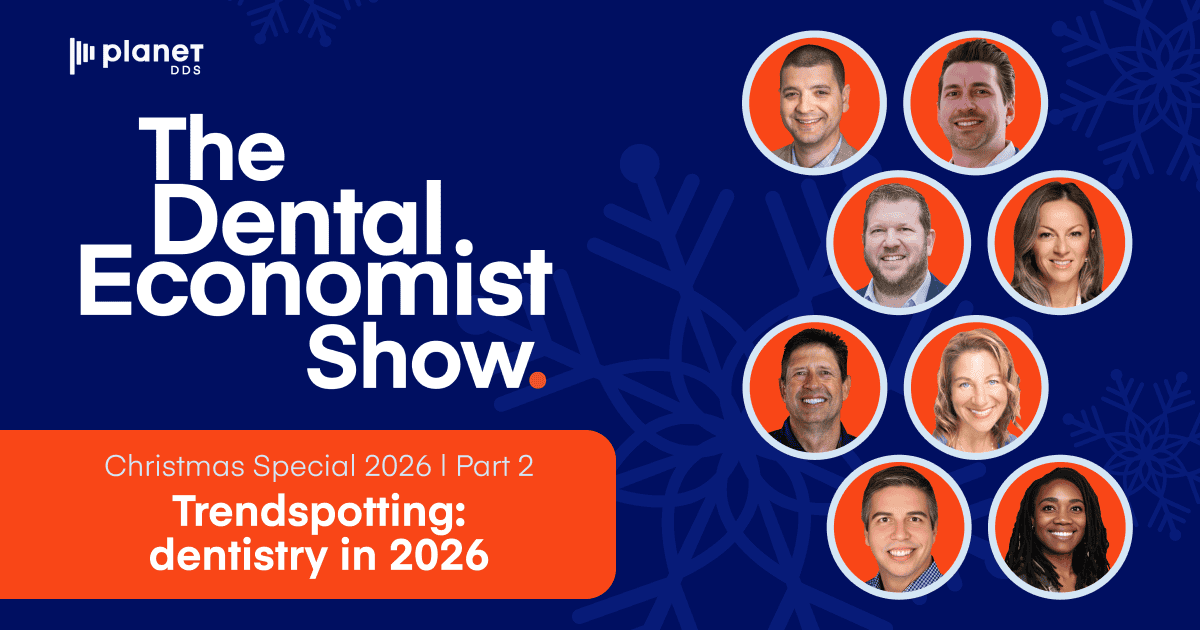
Practice integration, patient convenience and automation are all set to take over the dental landscape in 2026 (among other big trends) and we’re unpacking it all in the last episode of The Dental Economist Show of the year! Tune in as host CRO Mike Huffaker of Planet DDS, brings back some of the show’s biggest hits, courtesy Eric Pastan, Mariz Tanious, and Tobi Bosede.
What you’ll learn:
- How to leverage AI for cleaner data insights without overwhelming your team
- Why integration and enterprise-wide visibility matter more than EBITDA alone, from an acquisition standpoint
- The automation framework for solo and small practices
- How to roll out clinical AI adoption strategically: Always communicate the “why”, not just the “how”
- The culture-first DSO model as a competitive advantage
- How continuous learning across clinical, business, and people management disciplines keeps you ahead
Join us in saying “goodbye” to 2025 and “bring it on” to 2026!
Episode Highlights
From practice integration to automation, this retrospective edition of the podcast is just the rundown you need to sail into 2026 and own the year in dentistry. Here are some highlights from the show:
How clean data drives clinical wins
Eric Pastan, director of Elliot Davis, emphasizes that AI’s real superpower isn’t replacing dentists; it’s cleaning up messy data that’s currently scattered across spreadsheets and disconnected systems. For growth-minded dental leaders, this matters because systematic data pulls unlock insights that directly improve both clinical outcomes and operational efficiency. The worst thing that can happen is information overload without actionable intelligence.
If you find yourself in this position, Pastan suggests that you start by auditing your current data sources (practice management systems, clinical notes, patient records) to identify gaps and inconsistencies you’re managing manually. When you turn “dirty data” into clean intelligence, you gain a competitive edge that drives better decisions at every level of your business.
How automation levels the playing field
Mariz Tanious, chief dental officer at Affinity Dental Management, reveals that game-changing automation tools like 32 Health (AI-powered credentialing) and The Dental App (PMS with built-in CRM and AI consultant) are eliminating the resource gap between solo practices and large DSOs. This is valuable because solo practitioners and small groups no longer need a full leadership team to compete on marketing, operations, and compliance.
Previously, solo dentists couldn’t afford dedicated marketing managers, compliance officers, or business development specialists; they were simply outgunned. Now, cloud-based platforms with embedded AI consultants handle routine tasks and provide guidance, allowing a two-person office to operate with the sophistication of a twenty-person team. This democratization of tools means your competitive advantage now comes from execution and culture, not just size.
Culture-first strategy: The real differentiator in a consolidating market
Tobi Bosede, Founder and CEO of DentalFynd, identifies that as private practice continues to decline, the DSO that wins is the one delivering a private practice experience, not just operational efficiency. For dental leaders managing growth, this insight shifts the entire conversation from “How do we extract more EBITDA?” to “How do we attract and retain great dentists and team members?”
The challenge is that most DSOs chase standardization and cost-cutting, which alienates the independent-minded practitioners they’re trying to recruit. Instead, Bosede recommends positioning your group as a practice with autonomy, peer relationships and shared mission, not a corporate machine. By prioritizing culture and autonomy within a scalable structure, you build loyalty that outlasts margin optimization.
Integration and enterprise vision: What buyers actually want
Pastan shifts the conversation away from chasing EBITDA in isolation to building what he calls a “beautiful business,” one with unified systems, enterprise-wide KPIs and a clear growth plan. This matters because modern buyers (both financial and strategic) are sophisticated enough to recognize that disconnected practices simply mashed together aren’t a scalable platform. The mistake many operators make is assuming acquisition readiness equals profitability, when buyers are actually looking for infrastructure and management systems that enable continued growth post-deal.
Your action step: Conduct an integration audit: map your technology stack, financials tracking, and KPI visibility across all locations to identify what needs unification before you’re acquisition ready. When you think like an acquirer about your own business, you build something genuinely scalable and that attracts better capital partners.
Why change management trumps technology: Say “why” not “how”
Bosede shares a hard-won lesson: rolling out clinical AI tools without explaining the “why” to your team guarantees resistance, not because the tech is bad, but because it feels like more work. For dental leaders implementing innovations, this is critical because adoption failure isn’t usually a technology problem; it’s a communication and trust problem. The trap is launching shiny tools and expecting teams to figure out the benefit on their own.
Instead, Bosede recommends starting small and consistently reinforcing how each change makes their jobs easier, not harder. This approach teaches us that technology adoption is fundamentally about change management and your investment in communication and training often matters more than the tool itself.
Continuous learning across disciplines
Tanious lays out a multi-threaded learning approach: vendor education, dental journals, peer environments and non-dental leadership books like Surrounded by Idiots. That keeps leaders ahead of the curve. This is important because dental excellence is necessary but not sufficient; competitive advantage comes from understanding behavioral psychology, people management and business strategy alongside clinical knowledge. The gap most practitioners have is they optimize their clinical skills while treating business acumen as secondary.
Your move: Build a structured learning routine that spans four areas: clinical (journals), operational (vendor training), interpersonal (psychology/leadership books), and peer learning (network conversations). When you compound learning across disciplines, you develop judgment and adaptability that no single credential can provide. That’s what separates operators from leaders.
The Dental Economist Show
Don’t miss insightful conversations with industry experts on the latest trends and top strategies to grow your DSO or dental group. Tune in to The Dental Economist Show each week as we meet at the intersection of profit and purpose.
Listen to the full podcast: