Andrew Smith on Why DSOs Are Reshaping the Future of Dentistry
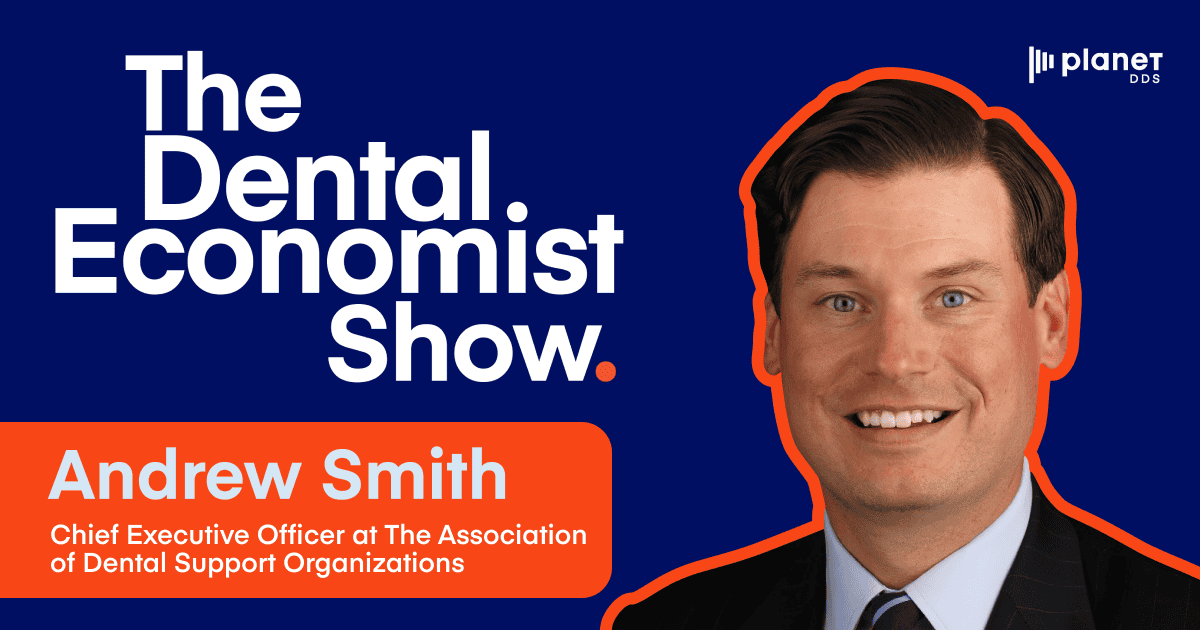
Have you ever thought about how dental support organizations (DSOs) have fundamentally shifted and redefined the dental market as a whole? In the latest episode of The Dental Economist Show, host CRO Mike Huffaker of Planet DDS sits down with Andrew Smith, CEO of the Association of Dental Support Organizations (ADSO), to explore the evolution of DSOs.
What you’ll learn:
- How to position your DSO for the next growth phase
- The operational systems that separate thriving DSOs from struggling ones
- Why licensing portability and dental insurance reform are critical regulatory wins
- How to defend DSO reputation amid private equity scrutiny
- The coming affordability conversation in public policy
- Why AI regulation for dental is 24 to 36 months away
Tune in for a conversation that traces all that’s happened and all that’s coming our way.
Episode Highlights
In this episode, Mike Huffaker sits down with Andrew Smith of ADSO to open up the pages of his strategic playbook. Here are some highlights from the show:
The evolution of the DSO
Andrew Smith explains that when he joined ADSO in 2021, DSOs still carried the “new kid on the block” mentality despite representing a significant market force, but this perception has fundamentally shifted as DSOs now comprise 30 percent of the dental marketplace more than 40 percent of new dental graduates entering the space. This transition matters because it signals that DSOs are no longer fighting for legitimacy; they’re reshaping how dentistry is practiced across America.
The challenge many DSO leaders face is understanding when and how to shift from defensive positioning to confident market leadership. A key step is recognizing that even the largest DSOs represent only two percent of the total oral health market, meaning there’s substantial white space for growth and diverse practice models.
Why operating systems and best practices matter in M&A success
Smith points out that DSOs which grew primarily through acquisition volume without building integrated operating systems and standardized best practices struggled to realize expected efficiencies, while companies like Heartland, PDS Health, and Smile Brands succeeded because they developed “phenomenal internal operating systems” that function as “very well-oiled machines.” This distinction is critical because many mid-market DSOs pursuing growth are tempted to chase acquisition targets without first establishing the operational infrastructure needed to integrate them successfully.
A practical approach is to focus on 12 to 24 months of same-store growth optimization while simultaneously documenting and scaling best practices across existing locations. This disciplined foundation positions DSOs for sustainable consolidation and higher valuation multiples when market conditions allow for strategic merger and acquisition (M&A).
Position your DSO’s affordability story now
Smith predicts that healthcare affordability will dominate public policy discourse for the foreseeable future, driven by political focus (Trump’s reelection, gubernatorial races across states) and real consumer pain around insurance premiums and out-of-pocket costs and DSOs must proactively demonstrate how they expand access and lower costs rather than limit them like some private equity-backed medical providers. This matters because DSOs are increasingly scrutinized under the same private equity lens that damaged healthcare systems in hospital consolidations, creating regulatory risk and reputational vulnerability for the entire sector.
The challenge is that many DSO leaders have not developed clear messaging about their cost-reduction and access-expansion strategies, leaving them vulnerable to legislation designed to prevent predatory private equity behavior. A key step is to quantify and articulate how your DSO improves affordability: reduced treatment costs through scale, flexible payment options, expanded clinical capacity, and geographic access improvements.
The strategic regulatory wins with immediate business impact
Smith describes ADSO’s multi-year focus on breaking down state licensing barriers (licensure reciprocity) and reforming dental insurance benefit utilization as core regulatory priorities that directly improve DSO operational efficiency and access metrics. These regulatory wins matter because they remove artificial friction. Dentists licensed in one state can practice across state lines more easily, and patients can access more of their insurance benefits, which increases revenue per patient and care utilization.
Many DSO operators underestimate how much state-by-state licensing complexity limits their ability to deploy talent flexibly across multi-state platforms or how insurance benefit caps limit revenue potential. A concrete step is to actively track licensure reciprocity progress in states where your DSO operates and allocate resources to support ADSO’s advocacy on dental insurance reform.
About The Dental Economist Show
Don’t miss insightful conversations with industry experts on the latest trends and top strategies to grow your DSO or dental group. Tune in to The Dental Economist Show each week as we meet at the intersection of profit and purpose.
Listen to the full podcast: