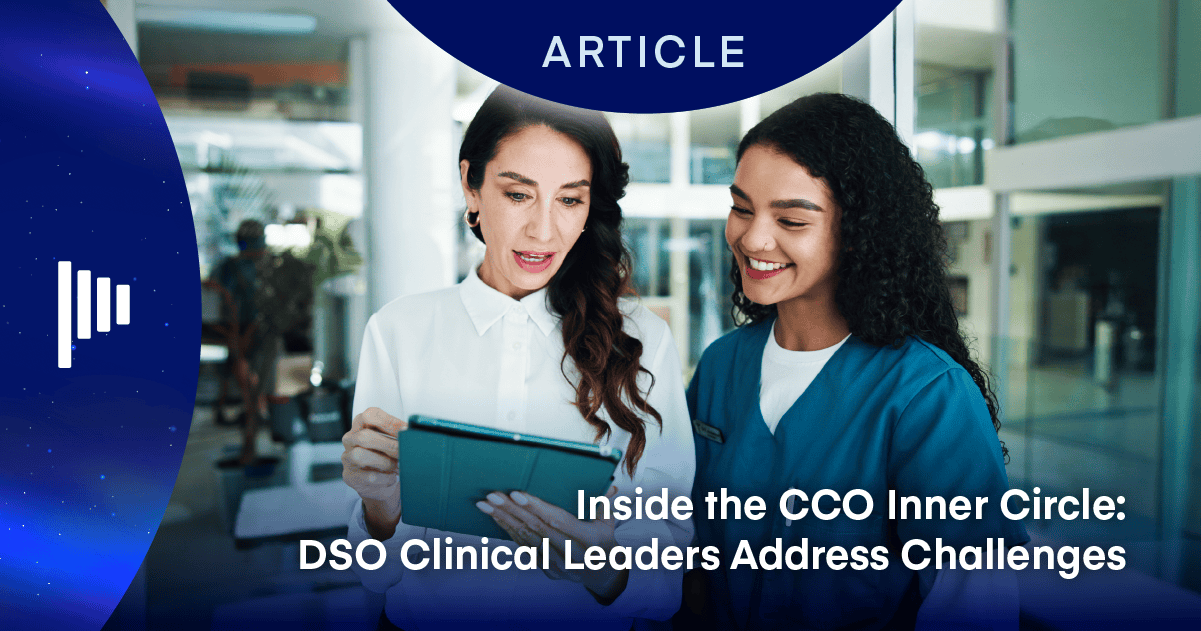
Inside the CCO Inner Circle: DSO Clinical Leaders Address Challenges
This article was written by Planet DDS and originally published in DrBiscuspid.com.
Clinical leaders across DSOs are often working through many of the same operational and clinical questions but rarely have the opportunity to discuss them openly with industry peers.
That was the idea behind the first-ever CCO Inner Circle meeting, organized by Dr. Sameer Puri, chief clinical officer at Imagen Dental Partners, with one ground rule: everyone must be brutally honest.
Held at Imagen’s headquarters in Scottsdale, Arizona, the unprecedented two-day gathering brought together thirty chief clinical officers from DSOs across the country to tackle shared challenges in hygiene, associate development, clinical autonomy, and AI.
What started as an idea to get a small group together for conversation quickly evolved into broader discussions around the realities of leading clinical operations across growing dental organizations.
The First-Ever Meeting for DSO CCOs
When Dr. Puri joined Imagen as CCO, he found himself without a peer community. He had spent thirty years in dentistry, spanning private practice, dental education, and lecturing, but the group practice world was new territory.
With encouragement from his CEO Rezwan Manji and support from dental industry partners Planet DDS and Overjet, Dr. Puri compiled contact lists and started texting clinical officers he had never met.
“We thought, hey, let’s get ten people in a room and have a good conversation,” Dr. Puri said. “We ended up having about thirty chief dental officers.”
Leading Through Conversations, Not Presentations
The agenda grew directly from pain points Dr. Puri’s own organization was navigating. He also made a deliberate choice to avoid the standard conference format.
“What I didn’t want to do was to assign speakers where you put together a PowerPoint and we listen for an hour,” expressed Dr. Puri. “There were too many smart people in the room to not hear from everyone.”
Each session ran about an hour, with one attendee framing a topic before opening the floor. A presentation by Wave Dental’s Dr. Steven Wingfield on hygiene and scaling and root planing sparked one of the meeting’s most focused exchanges, with the consensus being that organizations need a clear, top-down protocol with no ambiguity when it comes to periodontal disease diagnosis and treatment.
“There should be no confusion,” Dr. Puri explained. “Put in whatever parameters you need to put into your organization and treat what comes out of that.”
Hygiene Workflows and Associate Development
Hygiene was a hot topic. The group discussed doctor-led models, assisted hygiene, robotic hygiene, and the financial pressure dentists face around staffing costs. Dr. Puri noted that many organizations are rethinking the hygienist’s role, including deploying dedicated assistants to handle setup and room turnover so hygienists can focus on higher-level clinical work.
“We’re treating them like providers,” Dr. Puri said. “We’re treating them to the level of their credentials. We don’t expect a doctor to set up and clean up a chair, so why are we having a highly compensated, highly trained hygienist perform tasks that we don’t expect doctors to do?”
Associate dentist development was equally pressing. The group agreed that preparation coming out of dental school has declined sharply. “We have dental students graduating that have never done a root canal,” Dr. Puri said. “Maybe they’ve done two crowns.”
For advanced procedures like implants, the CCOs agreed that you can’t just send dentists to a weekend course. Instead, they need mentoring and ongoing clinical support until they feel comfortable performing those procedures solo. “Nothing beats hands-on training for learning how to place implants,” expressed Dr. Puri.
For many DSOs, those conversations reinforced the importance of internal training, mentorship, and ongoing clinical support for newer associates.
Clarifying What Clinical Autonomy Means
Much of the discussion around clinical autonomy centered on distinguishing operational standardization, such as vendor selection, from actual clinical decision-making.
“We’re not telling them what material to use or what to do on the tooth,” explained Dr. Puri. “You’re just telling them, here are the vendors we use.”
In his experience, doctors have largely welcomed that clarity. “Our doctors are relieved to have some preferred choices that are vetted by their clinical colleagues and partners.”
This distinction matters for recruitment and retention. When doctors understand the difference between operational standardization and clinical decision-making, concerns around clinical autonomy often become less pronounced.
Identifying Where Dental AI Is Most Effective
AI ran as an undercurrent through multiple sessions, from diagnostic imaging to voice assistants to back-office automation. On the clinical side, the group discussed how AI tools can take subjectivity out of periodontal diagnosis. “Radiographic evidence of bone loss on Overjet, for example, is not going to be subjective,” Dr. Puri said.
When rolling out new clinical initiatives, the group agreed that pilots should be doctor-driven. “Anything clinical, it shouldn’t be ‘doc, just go use it,’” Dr. Puri said. “It should be a well-vetted, well-researched, debated process.”
Overall, Dr. Puri described the mood as pragmatic: “AI is here to stay and it’s part of our lives.”
Biggest Takeaways from the CCO Inner Circle
For many attendees, simply finding a peer group was the point. One chief clinical officer said, “It was one of my favorite events I’ve gone to. The networking was excellent. We’re all dealing with similar issues, so learning from others in the same position was very valuable.”
For Dr. Puri, the value was as much validation as discovery. “It wasn’t a-ha in terms of a new finding,” he said, “but a-ha in the sense of, I’ve been saying this for six months or six years and these other guys are having the same issues or have the same solutions.”
What Comes Next for the DSO CCO Group
Dr. Puri has created a communications channel to keep the group connected and is planning another full meeting in 2027. In the meantime, he is exploring smaller gatherings around conferences like Dykema and ADSO.
The response made the effort worthwhile. “It was very gratifying,” said Dr. Puri. “We’ve got a great group and we’re certainly going to do more of it.”
As the DSO model continues to mature, meetings like the CCO Inner Circle may become increasingly valuable for clinical leaders looking to exchange ideas and solve shared challenges across the industry.
Contact us to explore how the right technology and operational support can help strengthen clinical consistency and growth across your organization.