AI Voice Restorative Charting: Standardizing Clinical Documentation Across Locations
Restorative charting is one of the most common clinical workflows in general dentistry and one of the most difficult to standardize as organizations grow. Capturing decay, existing restorations, fractures, and treatment plans happen in almost every exam, yet the way those findings are documented often varies across locations.
In many organizations, clinical documentation still relies on a mix of typing during the exam, entering findings afterward, or coordinating with a second team member to transcribe notes.
These techniques may work in a single location, but across dental support organizations (DSOs) and dental groups, slight differences begin to add up. Without a standardized, repeatable process, clinical workflows become harder to manage across providers and locations.
AI voice-enabled capabilities in dental practice management software have changed this approach. Built into Denticon, AI Voice Restorative Charting gives multi-location dental organizations a consistent, governable model for restorative documentation at scale.
What Are Common Challenges with Restorative Charting?
Restorative charting significantly contributes to administrative burden and variability in how findings are recorded. In many practices, clinical notes already take up a substantial portion of the day, with dentists spending up to one to two hours daily on clinical notes alone.
As DSOs and dental groups expand, variation in how findings are captured and documented becomes more difficult to control. Common challenges include:
Variation across providers and locations
Each provider may document findings differently, and each office may develop its own workflow. Over time, these differences make records harder to compare across multi-locations, limiting alignment across the organization.
Interruptions during documentation
Clicking through charting interfaces, typing findings, or documenting after the exam can disrupt the clinical flow. These interruptions not only affect the pace of the appointment but also introduce differences in how information is captured.
Reliance on two-person workflows
Assistants or hygienists are often needed to transcribe clinician findings. While effective in some settings, this approach introduces dependency on staffing availability and adds coordination to the exam process.
Inconsistent documentation and errors
Studies show that up to 44% of manual charts can be inaccurate, resulting in poor record-keeping and inefficient, error-prone workflows. This affects the accuracy of charting records and makes reporting less reliable across locations.
Disconnected tools and workflows
Add-on tools may support specific use cases, but they often introduce separate systems and additional data paths. As organizations grow, these disconnected workflows can make it harder to maintain a unified clinical record.
Combined, these challenges make it difficult to maintain consistent, repeatable restorative documentation as organizations scale.
What Is AI Voice Restorative Charting?
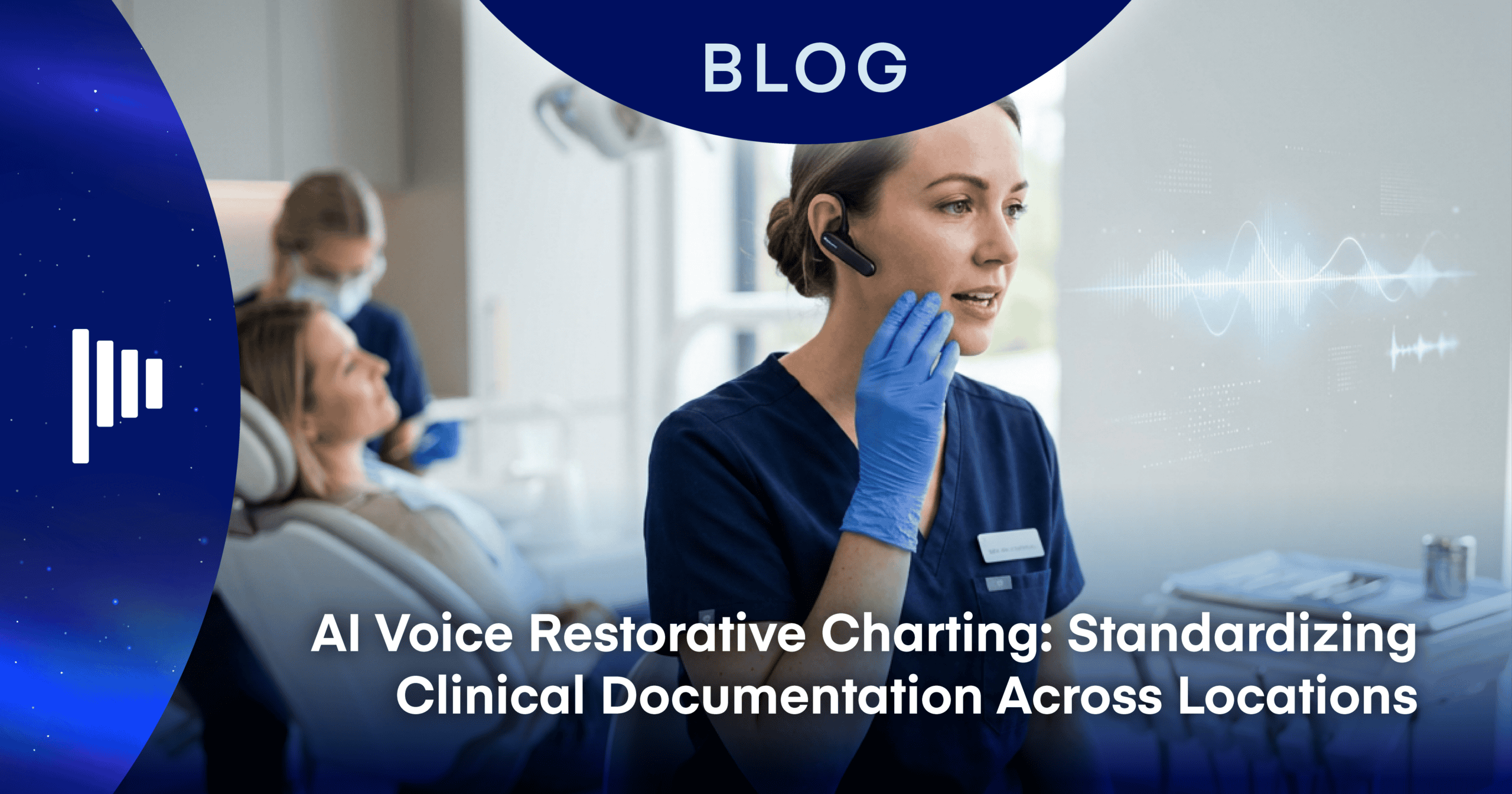
AI Voice Restorative Charting is a voice-driven capability built into Denticon, allowing clinicians to capture decay, existing restorations, fractures, implants, and treatment plan entries in real time as part of the clinical workflow.
Designed for DSOs and multi-location dental groups, AI Voice Restorative Charting supports a single-provider documentation model, reducing the need for a dedicated chairside scribe and helping clinical teams move through appointments with fewer interruptions.
See AI Voice Restorative Charting in action:
How Does AI Voice Restorative Charting Fit into Clinical Voice+ Suite?
The Clinical Voice+ Suite is a voice-driven clinical documentation model built directly into Denticon, designed to capture structured clinical data during the exam while maintaining consistency across DSO and dental group locations.
AI Voice Perio introduced this model for periodontal exams; AI Voice Restorative Charting extends it to restorative workflows, applying the same voice capture model, infrastructure, and governance controls to another high-volume area of clinical documentation.
By expanding this model across exam types, the Clinical Voice+ Suite supports more standardized documentation while keeping all data inside the Denticon system of record.
“AI Voice Perio proved that voice-driven clinical documentation can work at scale inside Dentico. AI Voice Restorative Charting takes that same model and extends it to where most of the charting volume actually lives. Practices have long accepted that restorative documentation requires two people or workarounds. We’re giving them a better option: one provider, charting by voice, in the same system they already use.” —Nathan James, CPO of Planet DDS
How Does AI Voice Restorative Charting Work?
AI Voice Restorative Charting is designed to fit naturally into the restorative exam while ensuring structured, real-time documentation inside Denticon.
During the exam, clinicians speak their findings aloud. The system recognizes dental terminology, abbreviations, and compound commands, interpreting spoken input and placing it into the appropriate Denticon fields in real time.
A voice overlay panel displays what has been captured as the clinician speaks, allowing for immediate confirmation. If a correction is needed, voice commands such as “Undo,” “Clear tooth 14,” or “Change that to amalgam” can be used without interrupting the workflow or reaching for a keyboard.
Because the information is captured directly within Denticon, AI Voice Restorative Charting acts as system of record immediately. There is no need for post-exam cleanup, re-entry, or reconciliation.
What Are Key Features of AI Voice Restorative Charting?
AI Voice Restorative Charting introduces a set of capabilities designed for real-time data capture inside Denticon. Top features include:
Voice-activated restorative charting
Clinicians can capture decay, existing restorations, fractures, implants, and treatment plan entries during the exam without interrupting the clinical workflow.
Real-time capture and in-exam corrections
Findings are captured as the clinician speaks, with a voice overlay panel confirming input and allowing for immediate corrections using natural voice commands.
Denticon-native structured data capture
Documentation is captured directly inside Denticon as structured data without relying on external tools or secondary systems. This improves visibility into clinical data while eliminating the need for syncing, re-entry, and post-exam reconciliation.
Single-clinician documentation workflow
One person can complete charting independently, reducing reliance on a chairside scribe and creating more predictable workflows across locations.
Standardized documentation across locations
A standardized model supports more comparable records across the organization, improving reporting clarity and reducing variability.
These features offer a modern AI approach to restorative charting across the organization, improving how data is captured and used.
How Does AI Voice Restorative Charting Improve Operations?
AI Voice Restorative Charting changes how restorative exams are performed by reducing interruptions, simplifying the process, and saving an estimated ten hours per provider each week. Clinical improvements include:
Hands-free documentation during exams
Speaking findings aloud reduces the need to pause and interact with the charting interface, allowing clinicians to remain focused on the patient.
A single-clinician workflow
Clinicians can complete documentation independently, reducing reliance on a chairside scribe and simplifying exam coordination.
Real-time capture without post-exam cleanup
Because all documentation occurs during the exam, there is no need to re-enter or adjust findings afterward.
More predictable workflows across clinical teams
Consistent processes help standardize how restorative exams are performed across locations and teams.
Reduced training burden as teams change
When documentation is guided by the system, new team members can align more quickly without relying solely on retraining or local habits.
These improvements help clinical teams move through restorative exams more efficiently while reducing interruptions throughout the process.
What Are Benefits for Dental Teams and Patients?
Consistent documentation enables stronger clinical oversight, more reliable reporting, and better experiences for patients. AI Voice Restorative Charting contributes to these outcomes by enabling:
More consistent clinical records across the organization
A shared model helps ensure restorative findings are captured similarly, giving dental teams more reliable information while improving patient care continuity.
Clearer, claim-supporting documentation
Structured capture produces more complete records for claims and follow-up care, helping teams reduce rework while ensuring patients receive timely, accurate treatment planning.
Improved reporting and visibility
Standardized data allows for more reliable reporting and real-time insights, helping organizations maintain oversight while giving clinical teams better understanding or patient patterns.
More efficient and focused exam experience
Reducing interruptions during charting allows clinicians to stay focused on the patient, enabling a smoother experience and more direct dentist-to-patient interaction.
Repeatable documentation model as organizations grow
As new locations are added, documentation remains uniform, helping teams deliver a unified experience while maintaining continuity for patients.
These outcomes optimize restorative charting while helping teams deliver a more patient-centric exam experience.
Bring Consistency to Restorative Charting at Scale
AI Voice Restorative Charting introduces a standardized method for restorative documentation by capturing findings in real time, directly inside Denticon. By removing reliance on manual entry, two-person workflows, and disconnected tools, it helps organizations establish a more consistent model for clinical teams across locations.
For DSOs and dental groups, maintaining reliable, standardized documentation becomes increasingly important, not just for daily operations but for reporting, oversight, and long-term growth.
Ready to establish a more consistent approach to restorative charting across your organization? Contact us to learn more.