Wardah Inam on Building the Most Advanced AI Dentistry Platform
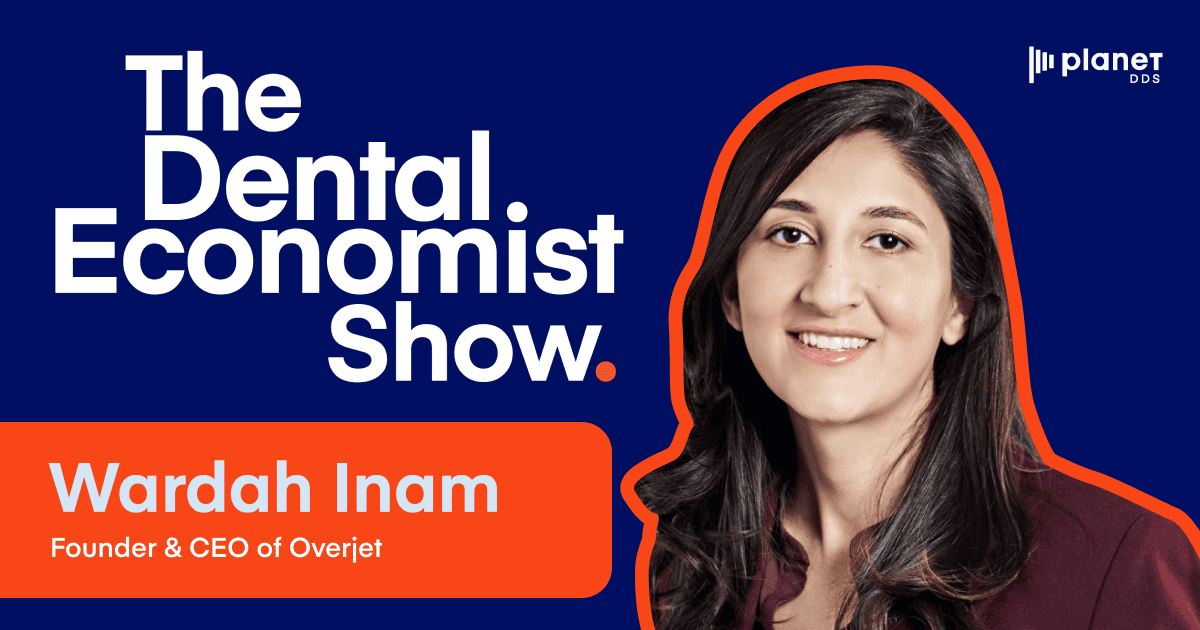
One doesn’t get to $80M in funding without being revolutionary. That’s the story of Wardah Inam-led Overjet, and we’re unpacking it in the latest episode of The Dental Economist Show with CRO Mike Huffaker of Planet DDS, as the CEO and co-founder lays bare her playbook on building the most advanced AI platform for dentistry.
What you’ll learn:
- How to shift from feature-based AI to practice-wide operational efficiency
- Why the “build vs. buy” decision matters when scaling AI products
- The practice management integration challenge and how to navigate it
- How to balance chaos with process as your organization scales
- Why quantifying culture and values drives better performance management
- How to identify your highest-impact CEO priorities
- The 2026 product roadmap signals where dental AI is heading
- Why dentists (and DSOs) are worth serving, and where the industry needs to evolve
Tune in for a timely reminder that ignoring the hype and focusing on the long game is what separates the winners from the losers.
Episode Highlights
In this episode, Wardah Inam reveals the ambitious roadmap she and her team developed: Practice OS, a vision to automate clinical and administrative workflows simultaneously.
Why a multi-year vision beats quarterly wins, every time
Inam developed Overjet’s roadmap back in 2019 and 2020 with a vision she calls the “Practice OS,” a comprehensive operating system for dental practices that extends far beyond a single diagnostic tool. This long-term thinking allowed her to anticipate how AI could evolve from clinical decision support into administrative automation, revenue cycle management (RCM), and voice transcription, even before large language models existed.
For dental entrepreneurs and DSO leaders, this insight emphasizes that sustainable competitive advantage comes from articulating where the industry is heading, not just solving today’s pain point. Rather than chasing quarterly metrics, Inam aligned her entire company roadmap around a multi-year thesis: reduce costs by automating variation in diagnosis and administration while improving patient care quality.
Don’t let PMS fragmentation paralyze you
The dental industry lacks interoperability standards (unlike healthcare’s FHIR standard), forcing companies like Overjet to invest enormous resources building custom integrations with dozens of different practice management systems. Inam points out that this fragmentation consumes engineering energy that could go toward innovation, creating a competitive disadvantage for everyone.
For dental business leaders, this is a critical insight: The systems you choose today (your PMS, imaging software, RCM tools) should be evaluated not just on features, but on their openness and API maturity. Rather than waiting for perfect industry standards, start demanding better API documentation and interoperability from your vendors now.
Balancing chaos and process as your team scales
Inam describes her CEO journey as constantly calibrating between two extremes: enough process to hire and scale beyond rock stars, but not so much process that you lose the magic and velocity of your founding team. For dental entrepreneurs scaling beyond 20 to 30 people, this is the critical inflection point where you need documented processes, onboarding systems and clear expectations (but not so much that every decision requires committee approval).
A practical framework: Identify which decisions are truly important versus those that just have to happen and spend your energy unblocking bottlenecks and setting culture, not micromanaging.
Position your AI technology as a time-giver, not a time-taker
Inam emphasizes that Overjet’s entire product philosophy centers on two levers: giving practitioners more time by automating documentation and administrative work and helping them use that time more effectively on high-value clinical decisions. Before adopting any software, ask: How much time does this save my team per day, and what higher-value work will they do with that time?
When you frame technology adoption as time reclamation rather than “digital transformation” you get faster buy-in from clinicians and you can measure return on investment (ROI) clearly. This shifts the conversation from “cool tech” to “practical relief,” which is what busy dental teams are actually looking for.
About The Dental Economist Show
Don’t miss insightful conversations with industry experts on the latest trends and top strategies to grow your DSO or dental group. Tune in to The Dental Economist Show each week as we meet at the intersection of profit and purpose.
Listen to the full podcast: