Scaling Smarter: Standardization Guide for DSOs and Dental Groups
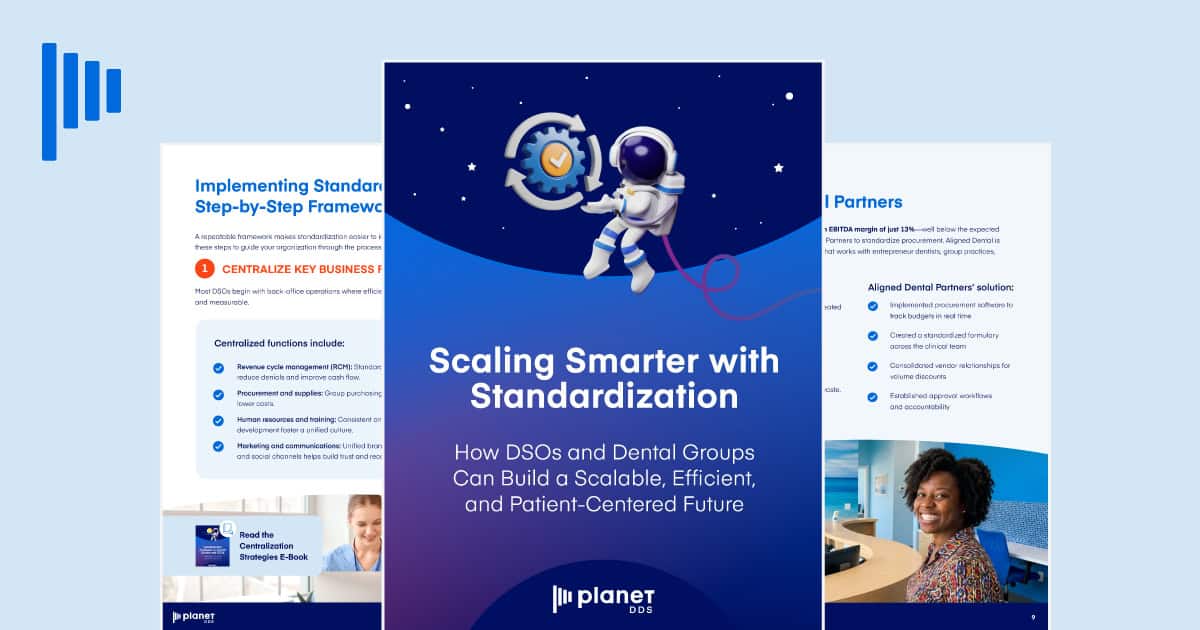
As dental support organizations (DSOs) and dental groups expand, the pressures on operations, technology, and patient experience grow quickly. Variation across locations becomes harder to manage, and small inconsistencies begin to affect quality, efficiency, and culture. Standardization helps organizations bring structure to that complexity. By aligning workflows, technology, and clinical approaches, teams gain shared expectations, patients receive a more consistent experience, and leadership has clearer insight into performance.
Scaling Smarter with Standardization explores how DSOs can use shared processes, unified technology, and consistent clinical protocols to strengthen operations and create a foundation for growth. The guide offers a structured framework DSOs can follow as they standardize workflows, support teams, and improve the patient experience across every location.
Why Standardization Matters to DSOs and Dental Groups
Standardization becomes essential as organizations grow. Without shared processes, each location creates its own version of “how things are done,” leading to inconsistencies in care, training, billing, and communication. Over time, these variations add friction to daily work and weaken both culture and performance.
Growth and operational expert Josh Gwinn, founder and CEO of Optimize Practice Alliance, explains the stakes clearly: “If you’re not standardizing and upgrading and providing a consistently excellent experience, you’re not going to keep those patients.”
Standardization creates clarity in daily operations, helping teams work more efficiently and consistently across every location. When workflows align, organizations reduce redundancy, strengthen quality, and create a more predictable foundation for long-term growth.
The Strategic Benefits of Standardization
Standardization touches nearly every part of a dental organization, from daily operations to financial performance to patient engagement. Each area strengthens the others, creating a more unified and dependable structure for teams across all locations.
A foundation for more efficient operations
Shared workflows reduce confusion, streamline training, and help new hires quickly understand expectations. Day-to-day work becomes more predictable, which boosts both performance and culture.
A pathway to scalable growth
As groups acquire practices or add new locations, standardized processes make onboarding smoother and reduce the operational strain that often follows rapid expansion.
Lower costs and stronger margins
Consolidating vendors, supplies, and systems creates economies of scale. Centralizing billing, HR, or marketing eliminates unnecessary duplication and strengthens accountability.
Higher quality and stronger compliance
Uniform clinical and administrative standards help ensure compliance and alignment across OSHA, HIPAA, and insurance requirements while also supporting consistent, evidence-based care.
Better data for better decisions
A single PMS (or fewer systems overall) enables more accurate reporting. Leadership can spot gaps faster, monitor key performance indicators (KPIs), and make continuous improvements.
A smoother patient experience
From communication to check-in to post-visit follow-up, patients experience fewer surprises when every location follows the same approach.
A clearer, more trusted brand
Consistency builds credibility. When marketing, messaging, and the patient satisfaction align, the organization’s identity strengthens across every location.
Standardization Starts with Mapping Processes
Before DSOs change workflows, they need clarity on how those workflows function today. Mapping the patient journey and the financial journey reveals where inconsistencies occur and where improvement will have the greatest impact.
Gwinn emphasized how transformative this step can be, noting that “standardization should start immediately, and it should start in two places,” referring to mapping both the full patient journey and the flow of money through the organization.
Mapping the patient journey
A complete view of the patient journey—from digital presence to scheduling to in-office flow and post-visit communication—helps identify friction points and variations that could be standardized for better outcomes.
Mapping the financial journey
Understanding how money moves through the organization is equally important. Billing accuracy, claim delays, and A/R differences often signal inconsistent processes. Gwinn notes that when his team unified five different practice management systems into one platform, “we created one source of truth for data and the bottom line tripled.”
Implementing Standardization: A Step-by-Step Framework
Once leadership understands how processes differ across locations and where the biggest gaps occur, the path toward standardization becomes much clearer. With that visibility, organizations can move from reactive problem-solving to a structured framework that introduces consistency in a manageable, intentional, and scalable way.
1. Centralize key business functions.
Most DSOs begin with functions that influence cost, efficiency, and consistency such as revenue cycle management, procurement, HR, and marketing. As organizations begin streamlining these areas, many teams also look toward broader centralization to strengthen alignment across locations.
2. Standardize clinical protocols for consistent care.
Clinical consistency builds trust with patients and supports reliable outcomes. Dr. Cindy Roark, chief clinical officer at Sage Dental, emphasizes the importance of evidence-based protocols and continuous retraining, noting that “you can’t have a cottage industry where you do something just because that’s the way you’ve always done it.”
3. Leverage technology to unify data and workflows.
Technology accelerates standardization. A single PMS, integrated APIs, and automation tools bring together clinical, operational, and financial data. Southern Orthodontic Partners moved from eight PMS platforms to one to simplify overhead and strengthen data consistency.
4. Define KPIs that measure success.
Clear metrics create accountability and track progress. Common KPIs include collection rate, denial percentage, no-show rates, case acceptance, and NPS.
5. Balance consistency with local autonomy
Standardization should empower teams, not restrict them. DSOs often allow flexibility in areas like community engagement or selection of materials within approved guidelines.
6. Lead through change with communication and clarity
Rolling out new systems requires transparency, training, and active leadership involvement. Gwinn reminds DSOs that communication is as important as the protocols themselves.
The ROI of Standardizing Workflows
Standardization leads to measurable improvement in performance, profitability, and patient satisfaction. DSOs see lower overhead, better financial visibility, stronger valuations during mergers or recapitalizations, higher provider and staff retention, and more consistent patient outcomes. These improvements strengthen organizational stability and support sustainable growth.
Building a Foundation for Sustainable Growth
Standardization aligns teams, clarifies expectations, and creates a dependable framework for both daily operations and future expansion. When organizations map their journeys, centralize core functions, unify technology, and define KPIs, they create the structure needed to scale with confidence. Together, these efforts help DSOs strengthen operations, improve patient engagement, and support steady, reliable growth across every location.
Discover how Planet DDS supports scalable growth for DSOs and dental groups. Contact us today to learn more.