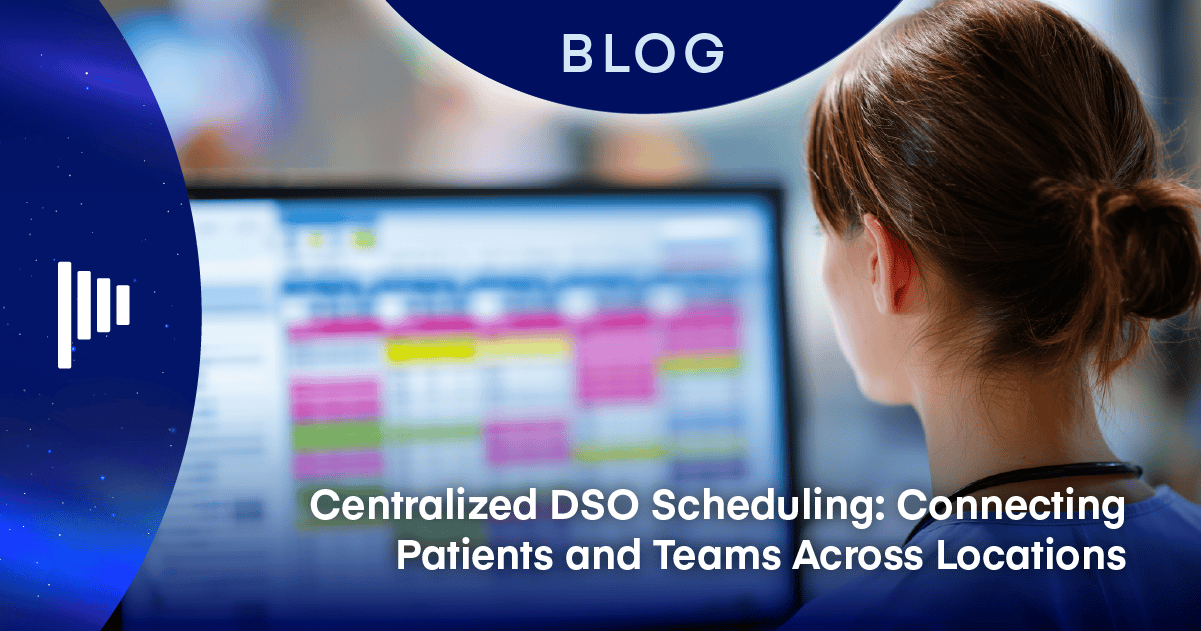
Centralized DSO Scheduling: Connecting Patients and Teams Across Locations
For dental support organizations (DSOs), scheduling has become much more than managing appointment availability. Every scheduled visit involves patient access, provider capacity, intake, confirmations, cancellations, recall, and the clinical and operational workflows that follow.
Those connections become more complex as organizations add locations and specialties. A process that works independently at ten practices can become difficult to coordinate across fifty or 100, particularly when teams rely on separate applications, patient records, and workflows.
Cloud-based dental practice management software is increasingly part of a broader technology ecosystem that brings DSO scheduling together with patient engagement, automation, AI, and other operational functions. Modern dental enterprise platforms bring these capabilities together, allowing technology to act on scheduling data rather than simply display it.
DentalOS® was built around that model. The dental enterprise platform connects scheduling and other operational capabilities through a shared data layer.
For DSOs, that creates an opportunity to view scheduling as a connected system that patients and teams can act on throughout the appointment lifecycle.
How Are DSOs Rethinking Scheduling?
DSO scheduling is becoming a more connected enterprise function as patient access, intake, confirmations, cancellations, recall, and AI-driven workflows increasingly intersect with the same appointment data. Coordinating those activities across locations requires DSO technology that connects the schedule with the broader operational environment while maintaining appropriate oversight.
Centralized DSO scheduling is now an enterprise function.
The traditional scheduling model focused largely on getting a patient into an available chair. Today, considerably more work happens around that appointment. Each interaction can change the schedule and generate information that another part of the organization needs.
New dental industry data illustrates the size of the opportunity. Patient Prism’s 2026 Dental Patient Access Report analyzed more than 11.5 million calls across 8,280 dental practice and DSO locations in 2025. Of 3.8 million patient opportunities, more than 1.4 million ended without an appointment, and more than 890,000 did not receive a callback. The company’s analysis found that insurance, scheduling, capacity, and service mix accounted for much of the lost opportunity.
For a multi-location organization, those findings point to an issue larger than front-desk performance. Leadership needs to understand where capacity exists, what prevents patients from reaching the schedule, and what happens when an appointment changes, or if a patient needs another interaction.
Centralized DSO scheduling can provide visibility across locations, but access alone does not sync the work surrounding the appointment. That requires scheduling information to remain available to the patient-facing tools, staff workflows, and increasingly AI-driven processes that act on it.
DentalOS connects scheduling to the enterprise.
DentalOS approaches scheduling from that broader perspective, connecting Denticon and Cloud 9 with patient engagement, AI, imaging, payments, and other capabilities on an integrated enterprise platform.
Rather than treating the schedule as an isolated practice-level function, DentalOS connects scheduling information with an extended infrastructure supporting operational efficiency across the organization.
That distinction becomes increasingly important as a DSO or dental group grows. Adding another location should not require rebuilding the surrounding scheduling workflows each time. Patient access, intake, appointment follow-up, and automation need a model that can extend across the organization while still accommodating differences among providers, locations, and specialties.
What Supports Centralized DSO Scheduling Across Locations?
DSO scheduling touches patient records, provider availability, communications, intake, and increasingly AI-driven workflows. Keeping those activities coordinated requires current data that can support the different teams and technologies acting on the schedule, making the architecture behind scheduling as important as the individual features.
A shared data layer keeps workflows connected.
Consider a cancellation. Removing an appointment from the calendar is only the first event. The patient may need to be contacted and offered another time. The newly available chair time may need to be filled. The patient record needs to reflect what happened. If the patient does not rebook, another follow-up workflow may eventually be required.
When separate systems handle each step, information has to move among applications and teams. Those handoffs multiply as an organization adds locations.
DentalOS connects enterprise capabilities through a shared data layer. Scheduling, patient, clinical, billing, and other operational data can support capabilities such as Patient+ and Agents+ without requiring an independent source of information for every workflow.
“Every capability we’re building … performs relative to the quality of the data beneath it. DentalOS is that foundational platform. We built the platform so that everything built on it today and in the future performs at a level disconnected tools never could.” —Nathan James, Chief Product Officer, Planet DDS
For DSO scheduling, the distinction is practical. An automated tool may need to know more than whether a slot appears open. It may need current patient information, the appropriate location and provider, scheduling rules, office hours, and what happened during previous interactions. Once it performs the work, the outcome also needs to return to the system teams use.
Integrations extend the scheduling environment.
A connected enterprise platform does not require a DSO to use one vendor for every technology need. Organizations may rely on specialized applications for communications, marketing, or other functions that interact with patient and appointment information.
Open APIs allow authorized applications to work with defined information and workflows while the underlying practice management software remains the system of record. DentalOS supports this approach through an open integration partner ecosystem, giving organizations the flexibility to connect specialized technology where it fits their operating model.
The important consideration is whether those connections extend the scheduling environment or create another independent source of data. As more applications and AI capabilities act on appointment information, DSOs need clarity around where scheduling data originates, how it moves, and where completed actions are recorded.
How Does Self-Scheduling Expand Patient Access?
Self-scheduling gives patients another way to interact directly with appointment availability while reducing the number of routine booking activities that require staff involvement. However, patient access is only part of the equation; scheduling and intake information also needs to remain connected to the systems and standards used across the organization.
Patient+ integrates access with operations.
The DentalOS Patient+ Suite brings patient communications, digital forms, and scheduling into the connected platform. Online scheduling can therefore function as part of the same operational ecosystem rather than as a separate patient-facing layer.
That centralization matters for multi-location groups because digital access creates another entry point into the schedule. If the patient-facing technology relies on disconnected information or requires staff to reconcile activity afterward, making scheduling more convenient for patients can create additional administrative work for teams.
Patient+ connects engagement with the schedule and patient information already used by the organization, allowing access to expand without requiring each location to manage an independent process.
This also creates an opportunity for greater consistency. Patient-facing scheduling, intake, and communications can follow common organizational standards rather than depending entirely on the processes established by each individual practice.
MyTooth brings patients into the schedule.
MyTooth, the self-scheduling and digital forms tool within the Patient+ Suite, gives patients direct access to live appointment availability and intake from a mobile device. Patients can self-schedule beyond front-desk hours and complete intake before arriving, with patient information flowing directly into Denticon and Cloud 9.
That direct connection also supports greater control over how information enters the organization. MyTooth allows teams to establish a common-form template and deploy it across locations, with permissions determining whether individual practices can make changes.
That combines patient access with enterprise governance. Patients gain another way to interact with the schedule while the organization can maintain greater consistency in how scheduling and intake information enters the system.
Dental365 has seen that combination in practice.
“With MyTooth, so much is automated now and our front desk teams can stay patient-focused instead of tied to the phone, and patients consistently praise how simple the online experience is. I’d absolutely recommend MyTooth to any DSO looking to save time and deliver a more modern, seamless patient journey.” —Etta Bourne, Vice President of System Integrations, Dental365
The goal is not to eliminate human involvement from scheduling. Some appointments and patient circumstances will always require staff judgment. Self-scheduling gives organizations another way to handle interactions that do not, while keeping the resulting information within the same operational environment.
How Are AI Agents Changing Scheduling?
AI agents are moving DSO scheduling automation beyond predefined reminders and task triggers toward technology that can complete defined operational work. Using live patient and scheduling information, agents can carry out appointment-related workflows and update the underlying dental software as those interactions occur, giving DSOs another way to execute repetitive work consistently across locations.
Agents+ adds an AI workforce into DentalOS.
The DentalOS Agents+ Suite applies autonomous AI workers to high-volume operational workflows. Unlike a stand-alone AI application working from exported or periodically synchronized information, Agents+ operates using live scheduling and patient data within DentalOS.
That difference allows an agent to do more than send a reminder or generate a task for staff; it can act on the information it encounters during an interaction. If a patient needs another appointment, for example, an agent can work with the live schedule, book an appropriate time, and update the system rather than leaving the outcome for a team member to reconcile later.
This adds operational capacity without requiring the same repetitive work to be performed independently at every practice. DSO scheduling rules and workflows can be established within the organization while agents perform defined tasks using the same underlying information teams rely on.
AI Agents act throughout the appointment lifecycle.
DentalOS AI Agents currently address several points where an appointment requires additional action. They extend AI-driven scheduling from the days before an appointment through recall, cancellations, and missed visits:
- AI Receptionist: This agent answers inbound patient calls and can schedule, reschedule, cancel, and confirm appointments directly in Denticon. It provides 24/7 scheduling coverage, helping capture appointment opportunities when staff are unavailable or managing other calls.
- Confirmation Agent: The agent automatically confirms upcoming appointments via outbound calls within a configurable window and can reschedule during the same interaction when needed. This allows confirmation activity to run without staff initiating each call.
- Recall Agent: The agent contacts overdue and upcoming recall patients automatically, and books accepted appointments directly into the schedule. It proactively works recall lists that might otherwise remain untouched when staff time is limited.
- Cancellation Rescheduling Agent: This agent follows up with patients who cancel to help book another appointment. It works the cancellation list to reach patients before more time passes and rebooks when the patient accepts.
- Missed Rescheduling Agent: This agent re-engages patients after a missed visit and can book a new time directly into the schedule. It follows up with low-pressure calls, so a no-show does not simply remain without another scheduling attempt.
The agents address different points in the appointment lifecycle where follow-up or another scheduling action is needed. Instead of technology only alerting a team that work needs to happen, AI can increasingly complete defined parts of that work within the same environment.
AI Agents allow consistent execution across locations.
The value of centralized DSO scheduling becomes more apparent at the DSO level. Confirmations need to happen every day. Recall lists continue to grow. Cancellations create openings that need to be recovered, and missed appointments require follow-up. When execution depends entirely on available staff time, the same workflow can be handled differently from one location or day to the next.
DentalOS AI Agents can run common workflows across locations while writing confirmations, reschedules, and bookings back into the practice management system in real time.
The AI Agents also include identity verification before protected health information is shared, consent and office-hours controls, HIPAA-secured voicemail, and an audit trail for interactions.
Missed appointments make the operational implications particularly clear. A 2026 systematic review published in the International Dental Journal described dental no-shows as a persistent challenge associated with wasted clinical resources, disrupted workflows, and financial loss. It also identified missed confirmations, previous no-show behavior, appointment timing, and longer scheduling lead times among important predictors while noting limitations in the existing research.
Planet DDS data adds practice-level context: The average dental practice sees a 15% no-show rate, costing more than $150,000 per provider annually in lost production, while 36% of patients who miss appointments report that they simply forgot.
The larger opportunity is consistent execution. A cancellation does not have to remain untouched until someone works on a list, and recall outreach does not have to depend on whether a particular team has time that afternoon. AI agents can perform defined scheduling work while the organization maintains oversight of the rules governing that work.
What Questions Should You Ask About DSO Scheduling Technology?
As DSO scheduling becomes more connected to patient engagement, AI, and enterprise operations, evaluating the DSO technology requires looking beyond individual features. The most useful questions help determine whether scheduling can support the organization’s broader operating model as locations, specialties, and technology needs grow:
- Does scheduling operate on the same patient record used throughout the organization?
- What happens to the data when a patient books, cancels, or reschedules through a digital channel?
- Can AI act directly on live schedules, or does staff still need to initiate or reconcile the work?
- Can scheduling and automation rules be governed across the organization while accommodating appropriate location and specialty differences?
- Does self-scheduling write directly into the systems teams use every day?
- How are permissions, auditability, and escalation handled when AI performs scheduling work?
- Can specialized applications connect without creating another independent source of patient or scheduling data?
- What additional systems, integrations, and administrative work are required each time another location is added?
These questions help distinguish technology that manages appointments from an infrastructure capable of supporting DSO scheduling across a growing dental enterprise.
Connect Your DSO Scheduling to the Dental Enterprise Platform
For DSOs, scheduling increasingly depends on the infrastructure surrounding the appointment and how effectively information can move into action across the organization.
DentalOS brings those functions together through a shared enterprise platform, with the Patient+ Suite extending scheduling and intake to patients and the Agents+ Suite applying AI to appointment-related workflows. Open APIs also allow organizations to connect specialized technology when needed.
As DSOs add locations, the larger consideration is whether the organization has the infrastructure to turn scheduling data into coordinated action across patients, teams, locations, and increasingly, AI.
Want to find out how centralized scheduling can support your DSO? Explore DentalOS enterprise platform solutions today.