The Dental Enterprise Era: Technology Built to Scale
Dental group practices are scaling faster than the infrastructure behind them. The organizations pulling ahead have built a single enterprise foundation, and the gap between them and everyone else is widening.
You can’t run what you can’t see. Enter the dental enterprise era.
The Dental Enterprise Era: Technology Built to Scale
28%
of dental care is now delivered through DSOs and group practices, up from <10% a decade ago
10,000+
dental locations operating under DSO or group practice management
3+
software vendors managed on average by a multi-location dental group
40 hours/month
spent per location on manual reporting, reconciliation, and data extraction
Your practices are growing. Your infrastructure hasn’t kept up
Piecemeal software stacks worked at five locations. But as you add locations, the costs multiply: in time, in revenue, and in decisions made from incomplete data. If these challenges sound familiar, it’s time to consider a dental enterprise platform.

No single view across locations
Executives are making production, staffing, and growth decisions on reports that are days old. By the time you see the problem, it’s already bigger.

Every acquisition restarts the integration process
When each new location brings its own tech stack, your team spends the first six months just getting connected.

AI is only as good as the data underneath it
Clinical AI, scheduling optimization, and revenue cycle automation: None of it performs when your data lives in five systems that don’t talk to each other.

Revenue is leaking and no one can find where
Fragmented billing systems across locations create invisible gaps in your revenue cycle. Missed claims, inconsistent fee schedules, and manual reconciliation compound across every practice in the portfolio.

Your ops team runs on manual workarounds
Spreadsheets stitching reports from ten systems. Calls to reconcile numbers that should reconcile themselves. That’s capacity your group can’t afford.
Four forces are redrawing the competitive map for dental groups
DSO leadership has always faced complexity. Four things are making the gap between enterprise-ready and operationally fragmented wider every year.

FORCE 1
Consolidation has hit critical mass
The DSO movement isn’t slowing. Organizations with enterprise infrastructure already in place will absorb new locations faster and more profitably. The groups moving fastest now will be hardest to catch.

FORCE 2
AI is separating data-ready groups from the rest
AI is moving from novelty to competitive necessity. None of it works on fragmented data. Groups that unified their data foundation are getting the returns. The rest are watching.

FORCE 3
The labor crisis rewards automation
Front desk staff and billers are harder to hire and harder to retain. Practices that automated routine workflows are running leaner. The ones still relying on manual processes are hiring into a shortage.

Force 4
Patient expectations have moved permanently
Patients expect the same experience at every location: online scheduling, digital intake, and consistent billing. One broken location affects the whole brand. Consistency at scale requires infrastructure.
The path forward begins with a dental enterprise platform
Denticon practice management software, built on DentalOS®, connects scheduling, billing, clinical records, imaging, and analytics across every location in your network.

Real-time visibility across every location
See production, collections, scheduling density, and clinical KPIs across your entire portfolio in a single dashboard. No manual extractions. No lag. No calls to location managers to reconcile numbers.

Standardized operations at scale
Roll out fee schedules, workflows, and policy changes across dozens of locations from a single admin console. When you update the template, every location gets it. Consistently.

Revenue cycle built for group practices
Integrate billing, claims management, and payment processing across every location, with reporting infrastructure built to surface revenue gaps before they become write-offs.
See what a dental enterprise platform looks like in practice.
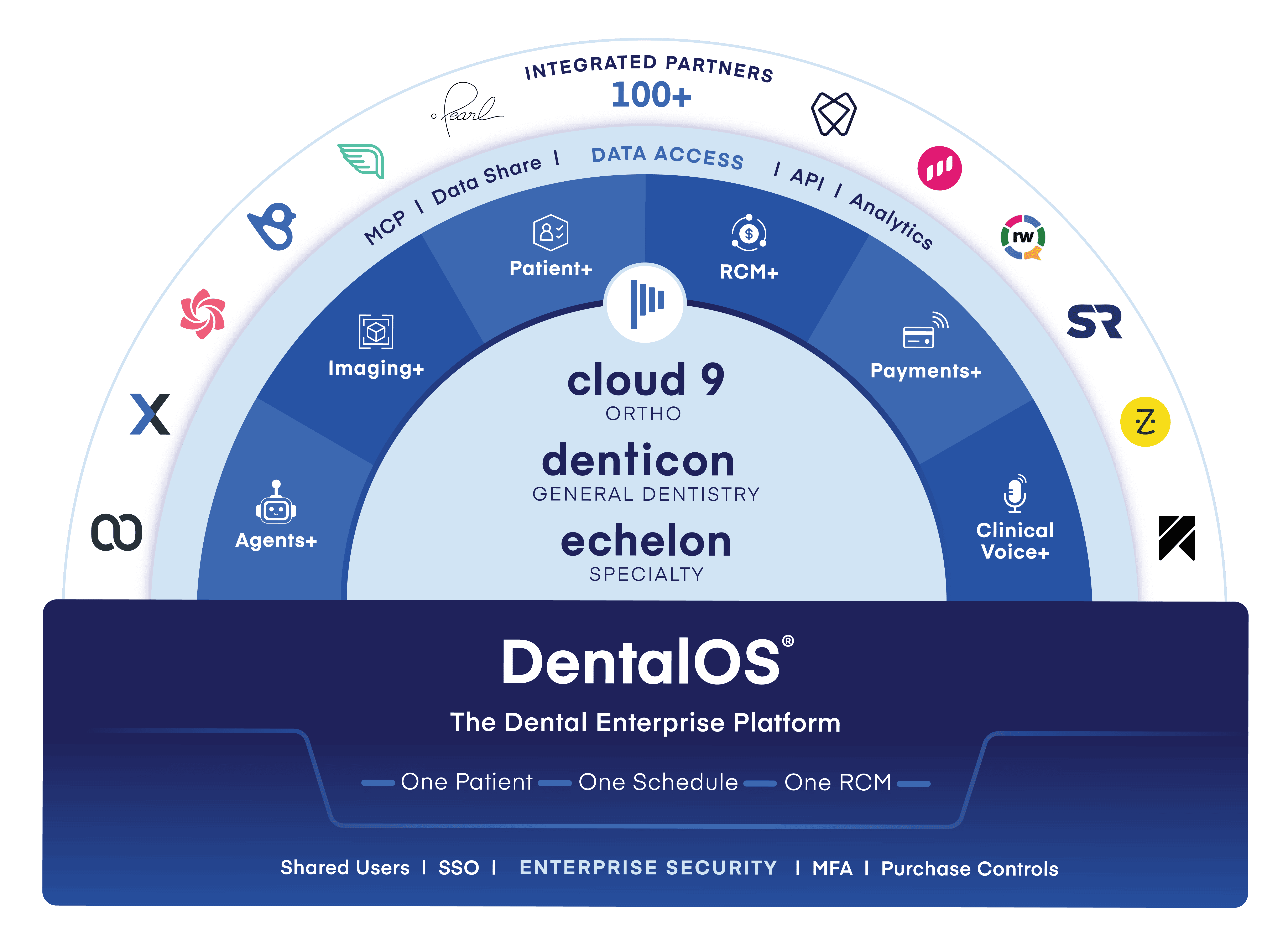
Request a demo to see how DentalOS can help you navigate the dental enterprise era
"*" indicates required fields